

Table of Contents
- Quick Answer
- Why is Malaysia’s construction boom creating more payment disputes?
- Why does CIPAA raise the stakes on weak documentation?
- Where does WhatsApp-based payment control break down?
- What does a defensible payment workflow look like?
- How does IntoAEC help?
- Frequently Asked Questions
Quick Answer
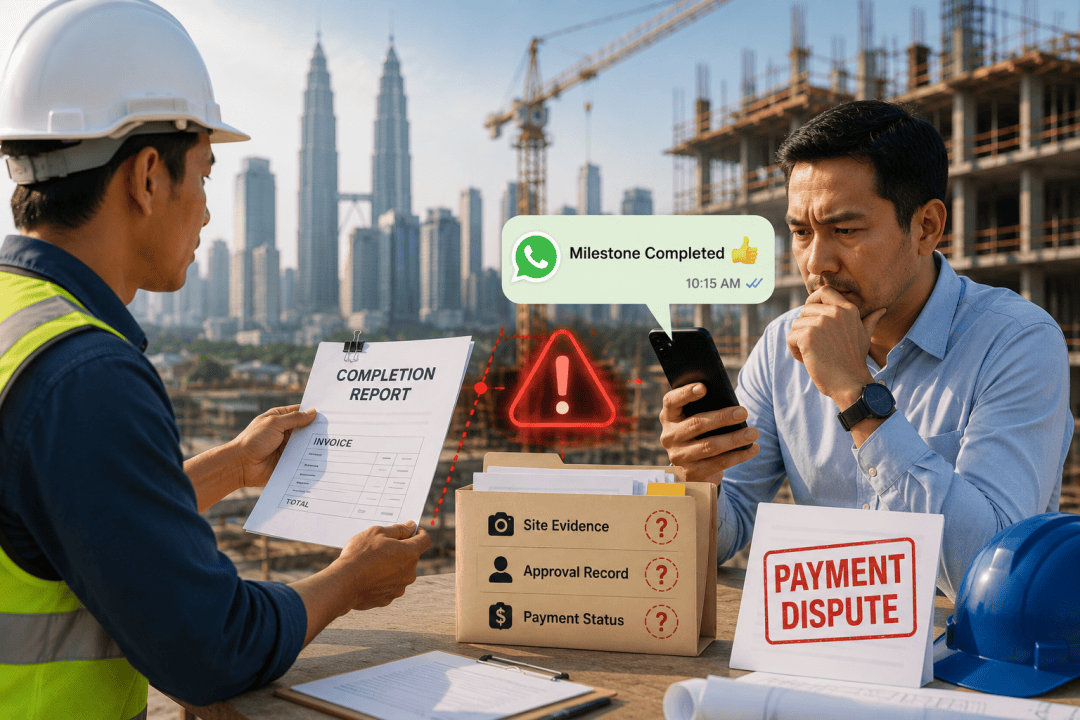
Most construction payment disputes Malaysia contractors face begin the same way: milestone completion, site evidence and approvals scattered across WhatsApp groups instead of a documented workflow. The stakes are rising. Malaysia’s construction sector grew 12.5% in 2025 to RM178.6 billion in work done value, with the subcontractor-heavy special trade activities sub-sector among the fastest growing. Under CIPAA 2012, payment disputes go to statutory adjudication where the side with documented evidence wins, and a thumbs-up emoji is not a payment certificate. Contractors need milestone completion linked to verified evidence, recorded approvals and payment status in one construction management system.
Why is Malaysia’s construction boom creating more payment disputes?
Malaysia’s construction industry is in a strong growth phase. The Department of Statistics Malaysia reports the sector expanded 12.5% in 2025 to reach RM178.6 billion in work done value, with double-digit momentum sustained through the fourth quarter (DOSM Construction Statistics, Q4 2025). Notably, the special trade activities sub-sector, the layer where most subcontractor packages sit, grew 28.3% in the first half of 2025, the fastest of any sub-sector (DOSM, Q2 2025).
That growth has a structural consequence. More work done means more subcontractor packages running in parallel under each main contractor: civil, MEP, interiors, waterproofing, aluminium, ceiling, flooring and specialist works. Every package carries milestone claims, retention, defect rectification and payment timing. And in many Malaysian construction businesses, all of that is coordinated through one tool: WhatsApp.
WhatsApp is fast and everyone has it. But it was never built to control payment. A milestone photo gets buried under a hundred site messages. “Noted” from a project manager gets read by the subcontractor as approval. Evidence sits in one chat, measurements in a spreadsheet, the payment request in email. When the subcontractor chases payment two weeks later, nobody can reconstruct who verified what, when, and against which BOQ item.
That gap is where disputes begin. And in Malaysia, disputes have a fast statutory route.
Why does CIPAA raise the stakes on weak documentation?
Since April 2014, the Construction Industry Payment and Adjudication Act 2012 (CIPAA) has given any unpaid party in a written construction contract a statutory right to adjudication, administered by the Asian International Arbitration Centre on a “pay now, argue later” basis. Parties cannot contract out of it (DLA Piper, CIPAA overview). The AIAC has consistently registered around 500 or more adjudication cases per year in recent reporting periods (Chambers Construction Law 2025, Malaysia), and an adjudicator’s decision is binding and enforceable unless set aside.
Two things follow for main contractors. First, a subcontractor who believes a milestone was approved over WhatsApp can take that claim to adjudication, and the contractor must respond within strict timeframes with documents, not memory. Second, recent case law confirms that adjudication turns on properly evidenced payment claims and responses. Malaysian courts have set aside decisions where statutory requirements around claims and procedural fairness were not met (Lexology, Samsung C&T v Berkat Honeywell, 2025).
In other words: under CIPAA, the party with the organised paper trail holds the advantage. A scroll of screenshots, emoji replies and undated site photos is a weak defence against a structured claim, and a weak basis for one.
Where does WhatsApp-based payment control break down?
Approvals are ambiguous. “Ok” from a site supervisor is not the same as QS-verified completion against the BOQ, yet both sides will later argue it was. Under standard Malaysian forms, whether PAM, PWD 203A or bespoke subcontracts, payment follows certified progress, not chat acknowledgements.
Evidence is scattered and undated in context. A photo proves work existed. It doesn’t prove which milestone it belongs to, whether defects were outstanding, or whether rectification was instructed. Dated, attributable daily site logs should make that timeline exist from day one. Instead, the project team spends hours reconstructing it when the accounts team asks.
Partial completion has no home. Most disputes are not “done vs not done”. They are 80% done with rectification pending. WhatsApp has no way to record a milestone as conditionally approved with a deduction, so the subcontractor invoices for 100% and the argument starts.
Management sees disputes, not exposure. Directors discover payment risk when a subcontractor escalates, or serves a CIPAA payment claim, rather than seeing live which packages have claims pending, approved, disputed or blocked. On a sector growing this fast, that blind spot compounds across every concurrent project. We covered a similar visibility gap in our story on how a Malaysian construction company fixed its site management.
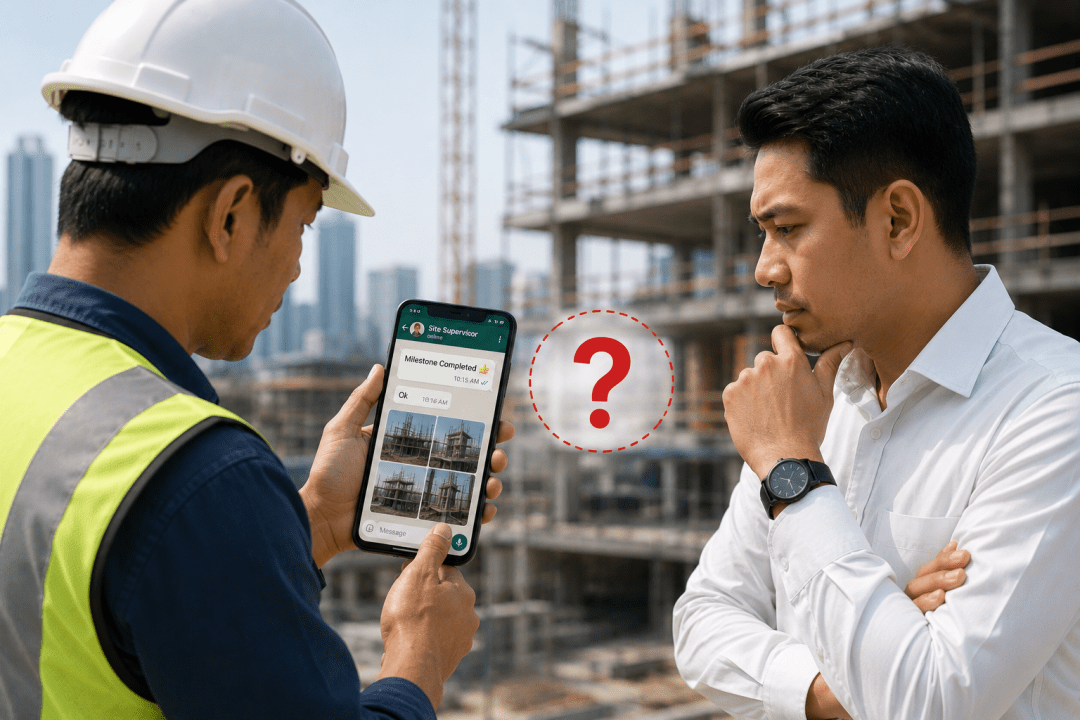
“Ok” in a WhatsApp chat is not QS-verified completion. Both sides will read it differently when payment is due.
What does a defensible payment workflow look like?
The fix is not banning WhatsApp. It is making sure payment decisions never depend on it. Each subcontractor package should link to its BOQ or scope items, with milestone completion captured through dated site updates and photos, inspection and approval status recorded against a named approver, deductions and retention visible, and payment release connected to verified progress. When the subcontractor says “milestone completed,” both sides should be looking at the same record, not competing screenshots.
That record serves the relationship in normal times and serves as evidence if a dispute ever reaches adjudication. Malaysian construction runs on repeat subcontractor networks. Clear records protect trust rather than replacing it.
How does IntoAEC help?
IntoAEC gives Malaysian contractors a structured workflow for subcontractor coordination and payment, built to prevent the construction payment disputes Malaysia’s adjudication caseload keeps growing on.
Subcontractor and vendor packages run through procurement: RFQs, quote comparison, purchase orders and GRNs matched against invoices, with role-based approval workflows before money moves. Daily logs and photo documentation capture dated, attributable site progress, while task management ties completion to named owners.
The Vendor Portal lets subcontractors view POs and manage their bills and invoices in one place at no cost to them, replacing payment-chasing messages with shared visibility. Invoices and payments are recorded centrally, with budget-versus-cost tracking showing management the live commercial position across every package.
The result: milestone evidence, approvals and payment status live in one system. WhatsApp goes back to being what it’s good at, quick communication.
Still approving subcontractor milestones with a thumbs-up in a WhatsApp group?
IntoAEC helps Malaysian contractors link verified site progress to documented approvals and payment release. One shared record for contractor and subcontractor, from PO to final payment.
Book a demo with IntoAEC and replace payment arguments with payment records, or start your 7-day free trial today.

Frequently Asked Questions
Because milestone completion, site evidence and approvals are managed informally across WhatsApp, Excel and email. Without a single documented record, contractor and subcontractor reconstruct events from chat history and disagree on whether work was completed, verified and approved for payment.
Yes. Under CIPAA 2012, any unpaid party to a written construction contract can refer a payment dispute to statutory adjudication administered by the AIAC. Parties cannot contract out of CIPAA, and decisions are binding and enforceable unless set aside by the High Court.
It is weak evidence. Chat replies like “ok” or “noted” are ambiguous, undated in context, and disconnected from the BOQ, inspection status and contract certification process. In a CIPAA adjudication, structured records carry far more weight: dated progress evidence, recorded approvals and certified amounts.
By linking each subcontractor milestone to dated site evidence, inspection status, a named approver and payment release in one workflow. Both parties then refer to the same record instead of arguing over message history, and the contractor holds defensible documentation if a dispute escalates.
Construction management software like IntoAEC connects subcontractor packages, procurement, daily site logs, approvals, invoices and payments in one platform, including a free Vendor Portal where subcontractors track their POs, bills and payment status directly.