

Table of contents
- What is a snagging list in construction?
- Why do handovers keep slipping?
- What should a structured snagging list actually contain?
- Snag list vs punch list: is there a difference?
- Why the Defects Liability Period makes this non-negotiable for UAE contractors
- How IntoAEC fixes the snagging process
- Conclusion
- Frequently Asked Questions
The final weeks before handover should be the easiest part of a construction project. The structure is up, the fit-out is done, and everyone is close to the finish line. Instead, for most UAE contractors, snagging season is where things quietly unravel. Items get missed on the walk-through. Trades are called back twice for the same defect. The client finds something the site team never logged. Handover slips by two weeks, then four, and the Defects Liability Period starts on a project that nobody is entirely sure is finished.
A structured snagging list doesn’t just tidy things up at the end. It’s what separates a clean handover from a messy one, and it’s what the data trail needs to look like when a dispute arises during the DLP under a FIDIC contract.
What is a snagging list in construction?
A snagging list is a formal record of defects, incomplete items and non-conformances identified before practical completion, so they can be assigned, tracked and closed before the keys change hands. In the UAE, where most commercial and infrastructure contracts sit under the FIDIC Red or Yellow Book, the snag list becomes part of the contractual record for the Defects Liability Period. Any item that isn’t logged before handover doesn’t disappear — it resurfaces later, either as a client complaint or as an ambiguous dispute about when the defect actually occurred.
The term “snag list” and “snagging list” are used interchangeably in the GCC, while US and some international contractors use “punch list” for the same document. The principle is identical: a written, assigned list of outstanding items with a clear resolution path.

Why do handovers keep slipping?
Most contractors don’t have a snagging problem. They have a snagging process problem. The actual defects are manageable. What isn’t manageable is trying to track them across a WhatsApp group, a shared Excel sheet three people are editing simultaneously, and a site foreman’s handwritten notebook that’s somewhere in the site office.
Three patterns show up repeatedly on UAE projects that miss their handover dates.
The walk-through produces a list, not a system. The site manager does a walk-through, notes items on a clipboard or in a message thread, and hands the trades a list. There’s no owner per item, no due date, no status field, and no mechanism for proving an item was actually closed rather than just assumed to be done.
Re-inspection loops eat the schedule. Because the first list wasn’t structured, the re-inspection finds items that were supposedly fixed but weren’t signed off properly. The client’s representative does their own walk-through and finds things that weren’t on the original list at all. The project is now running two or three overlapping snag lists with no single source of truth.
The DLP record is undefendable. When a client raises a defect six months into the DLP, the contractor needs to show whether it was logged before handover, when it was assigned, when it was closed, and what evidence was captured. If the snagging list was a set of WhatsApp messages and an unsigned Excel file, that defence falls apart quickly.
What should a structured snagging list actually contain?
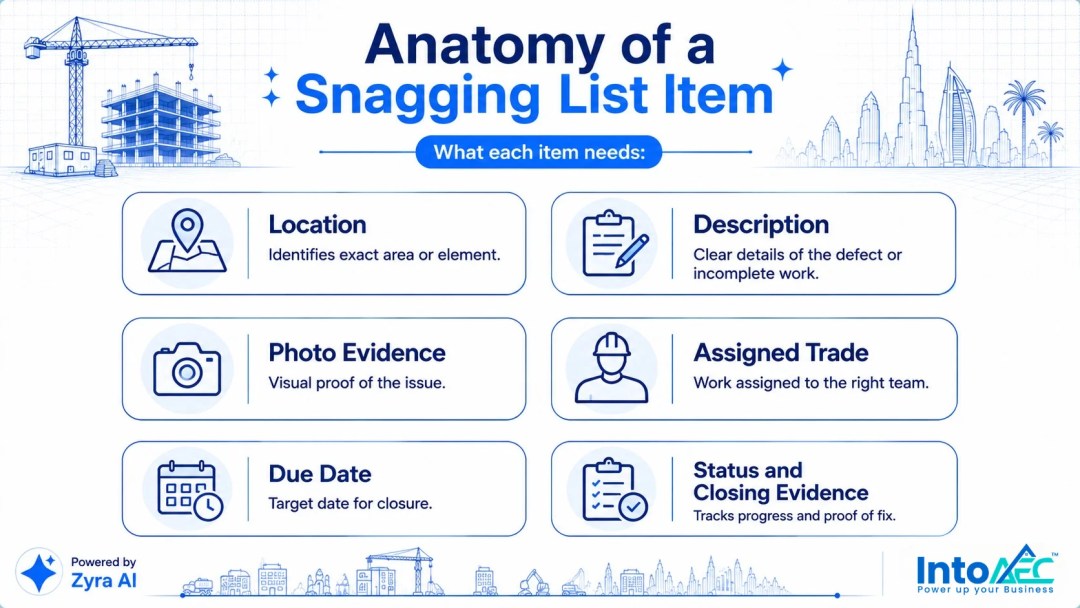
A snagging list that works through handover and holds up during the DLP needs more than a column of item descriptions. Each item should carry:
Location. Building, floor, zone or room — precise enough that a trade walking in for the first time can find the item without a phone call.
Description. A plain-language description of what the defect is, not just “ceiling issue” or “door problem.”
Photo evidence. Captured at the time of logging, not reconstructed later.
Assigned trade or subcontractor. One owner per item, not a general “MEP” or “finishes” label.
Due date. Based on when the item needs to be closed for the handover programme to hold.
Status. Open, in progress, pending sign-off, or closed — and the date of each status change.
Closing evidence. A photo or sign-off confirming the item is resolved, captured before the status changes to closed.
Snag list vs punch list: is there a difference?
In the UAE and across the GCC, “snag list” and “snagging list” are the standard terms. American contractors and some international project management frameworks use “punch list.” The documents serve the same purpose and carry the same contractual weight. If your FIDIC contract refers to a “list of outstanding work” or a “defects schedule,” both terms map to the same document. The label matters less than the structure behind it.
Why the Defects Liability Period makes this non-negotiable for UAE contractors
Under the FIDIC Red Book, which governs the majority of UAE commercial construction contracts, the Defects Liability Period typically runs for 12 months after the Taking-Over Certificate is issued. During that period, the contractor is obliged to fix any defects notified by the Engineer. Whether a defect was logged before or after handover — and who is responsible for it — depends entirely on the quality of the snagging record at practical completion.
A clean, timestamped snagging list that shows every item was identified, assigned and closed before handover is the contractor’s best protection against a disputed DLP claim. A WhatsApp message thread is not.
How IntoAEC fixes the snagging process
IntoAEC’s Project Management module gives site teams a centralised place to log, assign and close snag items with photo evidence attached, without rebuilding the process from scratch for every project. Each item carries an owner, a due date and a status trail, so the re-inspection loop doesn’t happen twice for the same item. When the client’s representative does their walk-through, the site team already has a live view of what’s open, what’s in progress and what’s been closed with evidence — not a printed list that was accurate three days ago.
Zyra AI handles the logging and formatting behind the scenes, so your site managers are capturing defects instead of transcribing them. You don’t interact with the AI. You just stop losing handovers to paperwork.
Conclusion
Snagging delays rarely come from the defects themselves. They come from the process, or the absence of one. A structured snagging list with clear ownership, due dates and photo evidence closes that gap, protects the contractor through the DLP, and gives the client a handover they can trust. For UAE contractors working under FIDIC contracts, that record isn’t optional. It’s the difference between a clean sign-off and a twelve-month dispute.
See how IntoAEC’s project management module structures your snag list from the first walk-through to final sign-off.

Frequently Asked Questions
A snagging list is a formal record of defects, incomplete items and non-conformances identified before practical completion. Each item is assigned to a responsible trade, given a due date, and closed with evidence before the project is handed over to the client.
They’re the same document with different names. “Snag list” and “snagging list” are standard in the UAE, GCC and UK. “Punch list” is the US equivalent. Both record outstanding defects before handover and serve the same contractual purpose.
Under the FIDIC Red Book, the Defects Liability Period depends on what was logged before handover. A clear, timestamped snagging list shows which defects were identified and closed before the Taking-Over Certificate was issued, which is the contractor’s primary protection against disputed DLP claims.
As a minimum: a precise location, a plain-language defect description, a photo taken at the time of logging, an assigned trade or subcontractor, a due date, and closing evidence confirming the item was resolved.
Centralised snagging software gives every item a visible owner, status and due date, so nothing gets lost between a walk-through and a trade callback. It also captures the photo trail needed to defend against DLP disputes, which a shared spreadsheet or message thread cannot reliably do.
Related articles
📄 Best Snagging & Audit Software in the UK: An Honest Comparison for 2026
📄 Hours Lost to Document Hunting and Endless Review Cycles? How IntoAEC Organises Drawings, Approvals and Project Handover Records
📄 How to Choose the Best Project Management Software for AEC Firms in 2025