


Table of contents
- Quick Answer
- What Does Monthly Excel CVR Actually Cost a UK Contractor?
- Why Does Excel Fail as a Live Commercial Tool?
- What Does a Live Cost-to-Complete Dashboard Actually Change?
- How Does IntoAEC Give UK Contractors Live Commercial Control?
- Frequently Asked Questions
Quick Answer
A monthly Excel CVR tells you what happened last month. Cost value reconciliation software tells you what is happening now. UK contractors relying solely on month-end reporting lose the window to protect margin, because by the time the report lands, costs have already moved. A live cost-to-complete dashboard keeps the QS, finance and procurement teams on one current commercial position instead of four conflicting ones.
Cost Value Reconciliation is the backbone of UK construction commercial management. QS teams, commercial managers and finance directors depend on it to understand project margin, committed cost and forecast final account.
But here is the problem most contractors do not say out loud: by the time the monthly CVR is finished, the project has moved.
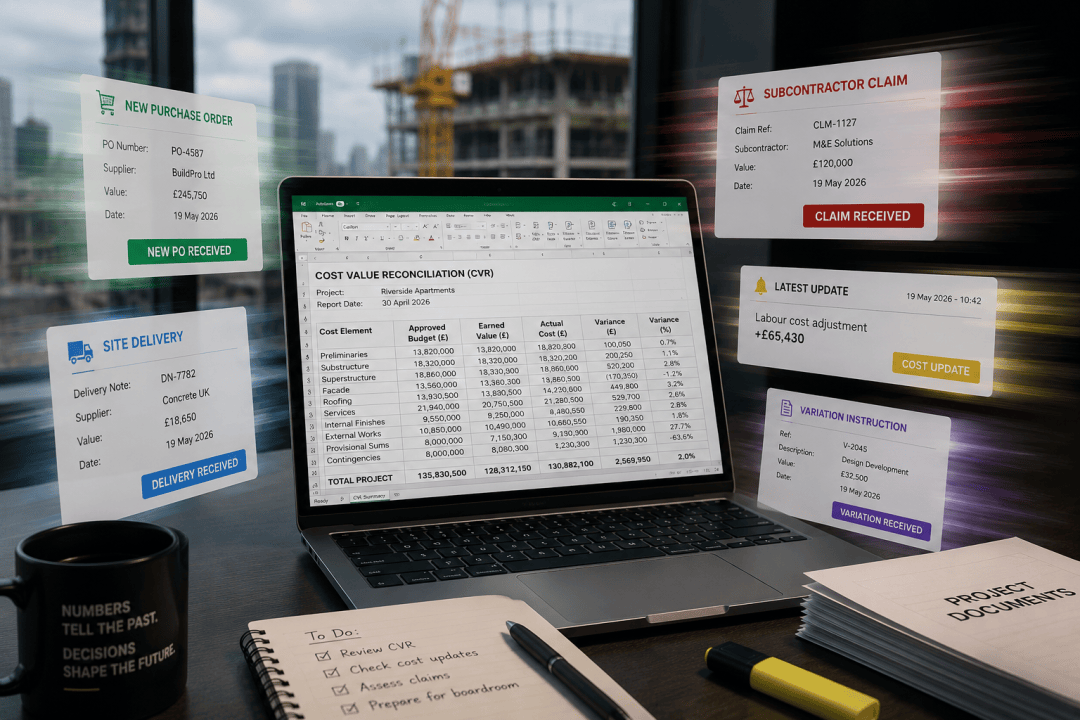
Procurement has raised new purchase orders. Site has consumed more materials. A subcontractor has submitted a new claim. A variation that was pending approval last week is now in dispute. The HGCRA payment notice clock is already running.
The QS team spent three days building a report that was accurate when it was compiled. It is no longer accurate today.
What Does Monthly Excel CVR Actually Cost a UK Contractor?
The visible cost is QS time, typically two to four days per project per month spent collecting, reconciling and formatting data from procurement, finance, site and subcontractor records.
The hidden cost is delayed commercial decisions.
Under JCT and NEC contracts, time-critical notifications such as loss and expense claims, early warnings and compensation event assessments depend on having an accurate commercial picture. A QS working from last month’s numbers is commercially exposed before they even open the contract.
The Housing Grants, Construction and Regeneration Act (HGCRA) adds further pressure. Payment cycles are strict. Missing a payment notice deadline because finance and the QS were working from different numbers is not just an administrative error. It is a cash flow risk that connected invoice and payment tracking is designed to remove. RICS guidance on cost reporting emphasises timely, accurate cost-to-complete forecasting for exactly this reason.
Why Does Excel Fail as a Live Commercial Tool?
Excel is not the problem. The problem is using Excel as the live commercial operating system for a project that changes every day.
Every Excel CVR shares the same structural weakness: it is a snapshot, not a stream. It captures what was true when someone last updated it. Between updates, procurement, site and finance continue generating cost data the CVR cannot see.
The result is that every department ends up with different numbers. Finance looks at invoices received. Procurement looks at committed purchase orders. The QS looks at forecast cost-to-complete. Site looks at materials consumed. Management looks at a summary that reconciles none of these in real time.
Monthly CVR meetings become debates about which number is correct, rather than decisions about what to do next.
What Does a Live Cost-to-Complete Dashboard Actually Change?
A live cost-to-complete dashboard does not replace the QS. It removes the data administration work that was never the QS’s job in the first place.
When project cost data flows automatically from procurement, finance, site and subcontractor activity into one connected platform, the QS can see cost movement as it happens, not after manually collecting and reconciling it. Linking each project budget to live committed and actual cost is what makes that possible.
That shift matters because project losses do not appear suddenly. They accumulate through small, slow movements: a subcontractor claim not commercially captured, a preliminaries overrun tied to a programme delay, a variation instructed verbally but never formally submitted.
Live visibility means those movements are visible in time to act, to challenge a claim, accelerate a variation approval or escalate a risk before the margin is gone. We covered the wider cost-control picture in our guide to construction job costing software for UK contractors.
How Does IntoAEC Give UK Contractors Live Commercial Control?
IntoAEC works as cost value reconciliation software that connects project budgets, BOQs, procurement activity, purchase orders, subcontractor records, variation tracking and site updates in one platform. QS, finance, procurement and site teams share a single live commercial position.
Instead of a QS spending three days building a monthly Excel CVR from scattered data sources, the cost-to-complete position is always current. Finance and procurement see the same numbers the QS sees. Management does not wait until month-end to find out which projects are at risk.
The monthly CVR remains a formal commercial discipline. The live dashboard becomes the daily control layer in between.
Ready to move from monthly CVR to live cost-to-complete visibility?
Book a demo with IntoAEC to see how UK contractors connect QS, finance and procurement on one commercial platform, or start your 7-day free trial today.

Frequently Asked Questions
CVR stands for Cost Value Reconciliation. It is the commercial process UK contractors use to compare cost incurred against the value of work completed, in order to track project margin and forecast the final account.
A cost report shows what has been spent to date. A CVR goes further: it reconciles cost against the value of work earned, accounts for committed costs and variations, and forecasts the final cost and margin at completion. That forecast is why the CVR, not the cost report, is the document directors rely on.
Monthly CVR is standard practice, but RICS guidance and most commercial managers recommend reviewing cost-to-complete more frequently on live projects, particularly when subcontractor claims, variations or procurement movements are active. With cost value reconciliation software the data is live, so the question becomes when you choose to review it rather than how long it takes to prepare.
Excel is flexible, widely understood and easily customised by QS teams. The limitation is that it requires manual data collection, creates version-control risk and cannot connect live to procurement, finance and site activity.
IntoAEC connects project budgets, BOQs, purchase orders, procurement activity, subcontractor records and variation tracking in one platform. QS, finance and procurement teams share a live commercial position rather than reconciling separate data sources at month-end.