

Table of contents
Ask five people on a Malaysian construction site about the difference between quality assurance and quality control. You’ll usually get five different answers, or one long pause. The concepts aren’t complicated. Most sites simply never bother to draw the line. The QA/QC engineer inspects. So does the site supervisor. At handover, the consultant checks again. Everyone’s checking, but nobody’s actually assuring anything. A hairline crack in the plasterwork or an out-of-tolerance slab can turn up three weeks later as a client complaint. It should have been caught while the scaffolding was still up.
The quality assurance vs quality control confusion isn’t academic. It’s the reason defects slip past the people whose job it was to catch them. And it’s why so many Malaysian contractors spend the final weeks before handover firefighting instead of finishing.
What Quality Assurance Actually Means on a Construction Site
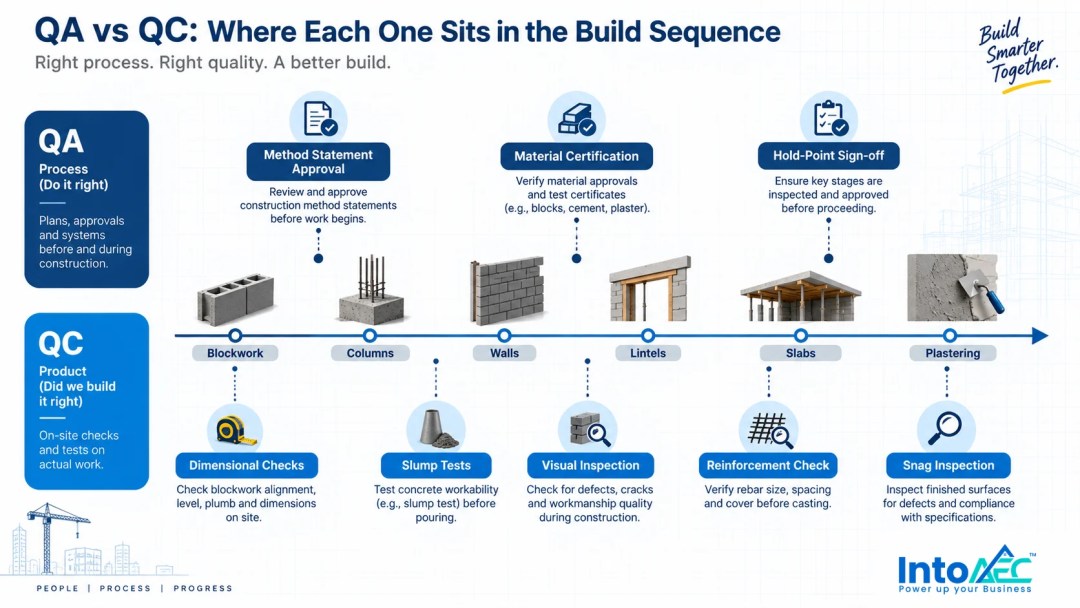
Quality assurance is the process work: the method statements, the approved material specifications, the inspection sequencing, the checklists that exist before a single block gets laid. QA answers one question upfront: if the team follows this process correctly, will the result meet spec? It’s proactive by design. A QA engineer doesn’t wait for a wall to go up before worrying about whether it will pass. They set the process that makes passing likely in the first place, then audit whether the team actually followed it.
On a Malaysian residential or commercial job, that means agreeing the concrete mix design and curing schedule before pour day. It also means confirming the rebar supplier’s mill certificates match spec, and setting the hold points that trigger sign-off before work continues to the next stage. None of it touches the finished product directly. It’s all upstream of the work.
What Quality Control Actually Means on a Construction Site
Inspection work is quality control’s domain: checking the finished product against the spec it needs to meet. QC is reactive by design, and that’s not a criticism. It’s supposed to be the safety net that catches whatever slipped through QA. A QC inspector measures the slab level once it’s poured, checks the tile grout lines once they’re laid, tests the concrete cube once it’s cured. If QA is “did we set up the process to succeed,” QC is “did this specific piece of work actually succeed.”
The problem starts when contractors treat QC as the only line of defence. By the time QC catches a problem, the work is already done. The team spots a misaligned door frame at snagging, not during installation. At the finishing walkthrough, the team catches a tile batch with an undisclosed shade variation—not at delivery. Every defect QC finds late costs more to fix than it would have upstream. On a tight Malaysian project timeline, that cost usually lands as delay, not just money.
Where the Confusion Usually Creeps In
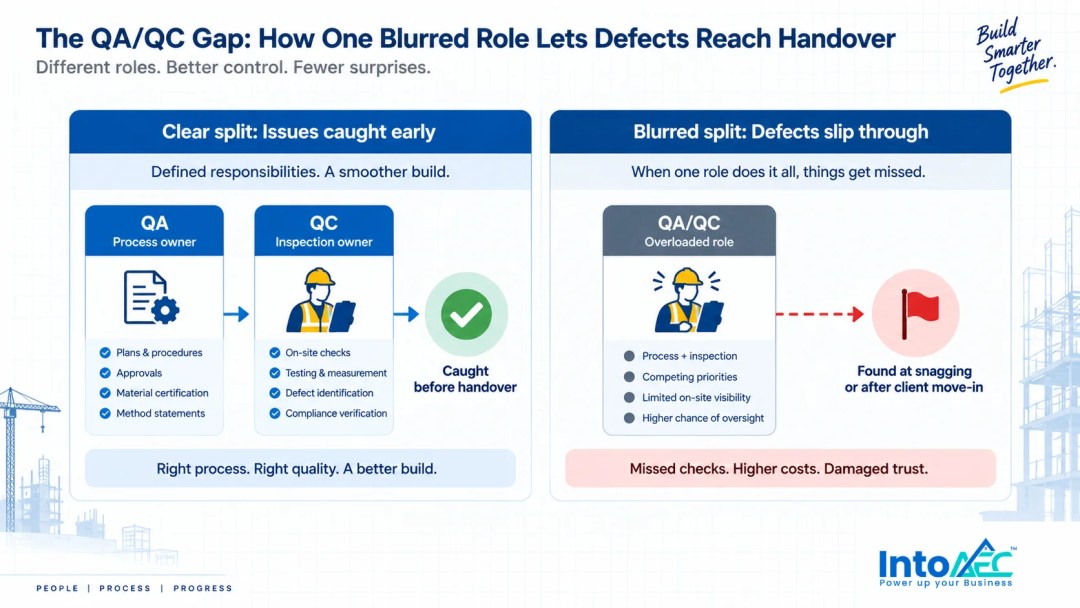
Most sites don’t lack quality processes entirely. They lack a clear split between who owns QA and who owns QC. The same person ends up doing both badly instead of either one well. A common pattern: the site engineer meant to run QA—checklists, hold points, material verification—drifts into daily firefighting. They start doing QC instead, walking the site with a checklist looking for defects that have already happened. Nobody’s left minding the process upstream, so the same category of defect keeps recurring, because nobody addressed the root cause.
Another common pattern on multi-trade Malaysian sites: QA responsibility sits with the main contractor’s engineer. Each subcontractor runs their own informal QC, with no shared checklist and no central record. The plumbing subcontractor signs off their own pipework. Tiling gets the same self-sign-off. When a leak shows up behind a finished wall six weeks later, there’s no clear audit trail of who checked what, and the defects liability period conversation turns adversarial fast.
Why the Mix-up Lets Defects Onto Site
Blurring QA and QC together has a practical effect: inspections happen, but too late and too inconsistently to catch problems while they’re still cheap to fix. Rework after plastering costs more than catching a levelling issue before it. During the client’s final walkthrough, a defect costs more—in both money and trust—than one caught during an internal QC pass a week earlier. A defect found after handover, inside the defects liability period, costs the most of all. It becomes a warranty call and a scheduling headache—and a mark against the contractor’s reputation with that client.
None of this is really about inspection effort. Most site teams are inspecting plenty. It’s about sequencing: whether the process-level QA work happens early enough that QC has less to catch. Visibility also matters—whether the team can track QC findings centrally, not in a notebook or a WhatsApp thread.
Building a QA/QC Split That Actually Works on Site
Fixing this doesn’t require a new department. It requires naming the split out loud and putting it into the site’s daily routine.
Assign QA and QC to different points in the workflow, not different people if the team is small. On smaller Malaysian projects, the same site engineer can genuinely own both. They just need to do QA tasks—reviewing method statements, confirming hold points—at the start of a work package, and QC tasks—measuring, testing, snagging—at the end. The failure mode isn’t one person doing both; it’s nobody doing the upstream half at all.
Put every QC finding in one place the whole team can see, not scattered across notebooks and chat threads. A defect that only lives in a supervisor’s head or a private WhatsApp message won’t resolve faster; the team forgets it until it resurfaces at snagging. Shared records, with photos and a timestamp, turn a verbal update into something the next site visit can actually verify.
Escalate deviations the same day they’re found, not at the next site meeting. A failed cube test, a delivery that doesn’t match the approved material spec, or a skipped hold point must reach the right person immediately. Three days later is too late—the next pour may already have gone ahead on the same faulty batch.
How IntoAEC Fits Into the QA/QC Workflow
Shared Records and Same-Day Escalation
IntoAEC doesn’t run your quality checklists for you, and it isn’t trying to be a dedicated QA/QC compliance module. What it does is remove the two things that usually break the split above: scattered records and slow escalation.
Every site update, defect note, photo, and milestone goes into IntoAEC’s Daily Report. A QC finding from Tuesday’s inspection sits in the same record as Monday’s delivery note and Wednesday’s progress update. Nothing ends up buried across three different apps.
When an inspection turns up a deviation serious enough to change scope—a redo on a failed section or a material swap—the Change Order feature captures it. It ties the change back to the estimate and routes it for client sign-off. The paper trail starts from the moment the team finds the defect, not weeks later from memory.
IntoAEC’s Alerting System also flags rule-based deviations across procurement, tasks, budgeting, and schedule. A skipped hold point or delayed inspection triggers a same-day notification to the right person—not a discovery at the next site meeting. When it’s time to update the client, the Client Report compiles daily logs, schedule status, and attachments in one place. A defect that got caught and fixed reads as evidence of a working process, not a hidden problem.
None of that replaces the judgement of a QA engineer deciding what the hold points should be, or a QC inspector deciding whether a finish passes. It just makes sure that once they’ve made that call, nothing drops the record.
Want to see how a real Malaysian project runs its daily site records inside IntoAEC? See how a Malaysian renewable energy contractor solved its site management challenges with IntoAEC. Or book a free demo and walk through the Daily Report and Change Order workflow with your own project in mind.

Frequently Asked Questions
Quality assurance is the process work done before and during construction, setting up method statements, material specs, and inspection hold points, so the result is more likely to meet spec. QC is the inspection work done on the finished product, checking dimensions, tests, and finishes against that spec. QA is proactive and process-focused; QC is reactive and product-focused.
Yes, on smaller sites it’s common and workable for one site engineer to own both, as long as they’re doing QA tasks (reviewing specs, confirming hold points) at the start of a work package and QC tasks (measuring, testing, snagging) at the end of it. The risk isn’t one person doing both roles; it’s the QA half getting skipped entirely under time pressure.
Usually because QA and QC records live in different places, or the team doesn’t log consistently, so a deviation one person catches early never reaches the person who needs to act on it. A shared, time-stamped daily record closes that gap far more reliably than relying on verbal handovers.
It becomes a warranty claim rather than an internal fix, which usually costs more in time and client trust than catching the same issue during construction. A DLP claim also pulls a team back onto a project they’ve already moved on from, which is disruptive for scheduling.
Not as a standalone module. IntoAEC centralises the daily records, defect notes, photos, and escalations that a QA/QC process generates, through Daily Report, Change Order, and Alerting, so nothing gets lost between the person who found a problem and the person who needs to fix it.


