

Table of contents
- What should a construction daily report record?
- Why daily reporting is important for project teams
- 5 ways structured Daily Reports improve project visibility
- Best practices for better Daily Reports
- How IntoAEC Daily Report keeps everything in one place
- Conclusion
- Frequently Asked Questions
If you’re managing a construction project in the UAE, you already know: the pace doesn’t stop.
Concrete pours happen before sunrise. A subcontractor misses a milestone. The afternoon heat pushes the crew off the slab. A material delivery lands three days late from Jebel Ali. And somewhere between all of that, your project manager is still chasing WhatsApp messages trying to figure out what actually happened on site.
As a result, by end of day, most of those details are already gone.
When updates are scattered across WhatsApp groups, phone calls, handwritten site registers and separate documents, it becomes nearly impossible for project teams and stakeholders to reconstruct what actually happened on any given day.
That’s where structured daily reporting changes everything.
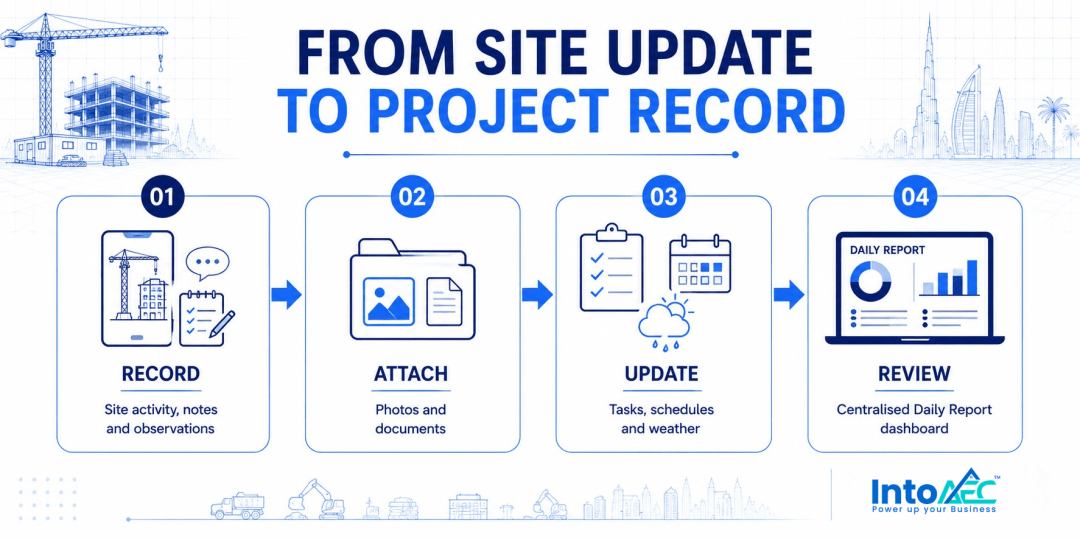
IntoAEC Daily Report gives your project team one organised place to capture it all — site activity, task progress, weather conditions, notes, photos and schedule updates. One platform. One record. No chasing.
Instead of piecing it together the next morning, teams capture information as it happens — and the record stays with the project.

What should a construction daily report record?
More importantly, a good daily report doesn’t just confirm that work happened. It tells the full story of the day — what was completed, what was blocked, what the conditions were on site, and what needs to be escalated before tomorrow.
IntoAEC Daily Report is built around the information UAE construction teams actually need on the ground.
Daily site activity
Record everything that happened on site — completed work, ongoing tasks, delays and important observations. On a UAE project with multiple subcontractors working across different zones, this daily log becomes the single source of truth for the whole team.
In turn, this gives the project team a reliable, day-by-day history of progress — one that doesn’t depend on anyone’s memory or a weekend catch-up call.
Tasks and schedule progress
Teams can link task and schedule progress directly within the daily report — connecting daily activity to the wider project timeline.
On UAE projects where handover dates are fixed and penalties apply, this connection between daily activity and schedule tracking is critical.
Notes and attachments
Daily reports can include notes, photos, documents and other supporting files — making them far more useful than a plain text log.
Instead of keeping site photos in someone’s phone and documents in a shared drive no one can find, everything stays with the relevant daily update.
Weather conditions
In the UAE, weather isn’t just a formality — from June to September, extreme heat can stop work mid-morning. Teams can record weather conditions in the daily report, including whether they affected productivity or caused a suspension of works.
That record is invaluable when reviewing delays, responding to consultant queries, or supporting a claim.
Why daily reporting is important for project teams
In the UAE construction industry, daily reporting isn’t about creating extra admin.
It’s about building an evidence trail — one that protects you when a client disputes a delay, a subcontractor denies a missed milestone, or a consultant questions what was on site on a specific day.
Think about what happens on a typical UAE project.
A concrete pour scheduled for 6am gets pushed — the ready-mix truck arrived three hours late from the batching plant.
Without a daily record, that delay disappears. It resurfaces two weeks later in a tense call with the main contractor — and no one can prove exactly what happened or when.
With a proper daily report, the team logged it the same day — with a timestamp, a note, a photo of the empty site at 6am, and a weather update. That’s the kind of documentation that holds up.
Over the lifecycle of a major UAE project, those daily records build into an undeniable project history.
Project managers, site engineers, office teams and client representatives in Dubai or Abu Dhabi can review exactly what happened on any given day — without waiting for the Friday summary call.
5 ways structured Daily Reports improve project visibility
1. Keep site records organised
Every day becomes part of the project’s documented history.
Teams across multiple zones and shifts can log work completed, site updates, notes and supporting documents in one consistent format — regardless of who’s on site that day.
No more reconstructing events from memory or digging through WhatsApp groups when a stakeholder asks what happened last Tuesday.
2. Improve team visibility
Not everyone on a UAE project is on site every day — or even in the same emirate. Directors in Abu Dhabi, consultants in Dubai, and client teams overseas all need visibility without being physically present.
A structured daily report gives project managers, office teams, consultants and remote stakeholders a clear view of what happened on site — without a single phone call.
Instead of waiting for the weekly update, they can check what was logged for any given day and get the full picture.
3. Track delays and issues clearly
Delays on UAE projects come from all directions. Teams may also need to raise RFIs when missing information or unresolved queries are holding up site activity.
A team may face:
- Missing materials
- Manpower concerns
- Weather impact
- Site problems
- Pending work
- Other blockers
Daily reports give the team a consistent place to document these issues the moment they happen — not after the fact.
That creates a clear, time-stamped reference for client updates, authority submissions and claim management — without scrambling to find the original notes.
4. Reduce manual reporting effort
Preparing daily updates manually through spreadsheets, calls and emails takes time.
A structured Daily Report gives site teams a single, consistent place to log updates — replacing the patchwork of WhatsApp messages, emails and verbal handovers that slow projects down.
The result: less time chasing updates, more time managing the project.
5. Support better accountability
Project managers assign daily reports to the right team member — so there’s always a clear owner for site updates. No ambiguity about who logged what, and when.
The central dashboard shows who created each report and when — giving project managers full visibility across the team, even on large multi-subcontractor UAE projects.
Best practices for better Daily Reports
The tool works best when teams build a consistent daily reporting habit. On UAE construction sites, where crews change, shifts overlap and subcontractors come and go, that consistency is everything.
Log daily, not weekly
Log updates on the same day they happen — not the next morning, and definitely not on Friday afternoon.
In a fast-moving UAE project, details from Monday are hard to recall by Wednesday. Therefore, encourage site users to complete their Daily Report before leaving site — it takes minutes and saves hours of follow-up later.
Attach photos and files
In addition, photos, documents and other supporting files make daily updates far more useful — especially during client walkthroughs, authority inspections or any dispute that arises months down the line.
Use notes for blockers
Record delays, missing materials, manpower shortfalls, access issues and other blockers in the report. If you’re waiting on an NOC, a municipality clearance, or a material shipment held at Jebel Ali, log it — those details matter when it comes to EOT claims.
Sync time logs and tasks
Link timesheet and task progress to keep your daily report consistent with what’s actually happening on the schedule — not what was planned three weeks ago.
Mark weather impact
When UAE summer heat, a sandstorm or unexpected rain affects the work, record the condition and clearly mark the impact in the Daily Report. It’s the difference between a protected EOT claim and an unsubstantiated one.
How IntoAEC Daily Report keeps everything in one place
Ultimately, the core purpose of IntoAEC Daily Report is simple: site information belongs in one organised system — not scattered across WhatsApp, email threads and paper logs.
Teams create daily logs containing site activity, notes, attachments, weather, task progress and schedule updates — all in a consistent format, captured every day.
Consequently, all reports flow into the central Daily Report dashboard, accessible to the entire project team — from the site engineer on the ground to the project director reviewing from the office.
The dashboard provides details such as:
- User
- Date
- Report title
- Weather
- Created by
- Created on
This gives the entire project team — from site supervisors to senior management — a consistent, reliable way to review what happened on site each day.
Furthermore, Daily Reports connect with tasks, schedules, timesheets, notes and attachments — creating a more complete record of project execution that goes well beyond a standard site diary.
For consultants and project managers on UAE projects, that means less time chasing site updates and a clearer picture of progress without having to leave the office.
Conclusion
Every day on a UAE construction project generates a new wave of decisions, delays, updates and observations.
The challenge isn’t that teams don’t know what happened — it’s that the information disappears before anyone can use it. Into a WhatsApp thread, a notebook, or a phone that got replaced.
Fortunately, a structured Daily Report solves that. Log what happened, attach the evidence, update the schedule, and keep the record tied to the project — every single day. That’s how UAE construction teams stay in control, protect their claims, and deliver on time.
IntoAEC helps teams capture daily site activity, task and schedule progress, notes, attachments, weather conditions and time-related information in one organised place.
The result is a clearer day-by-day record that helps project teams stay informed, document delays and maintain better project accountability.
Ready to bring your UAE site reporting under control?
Explore IntoAEC and see how structured Daily Reports can replace the chaos of WhatsApp updates with one organised, accountable system — built for the pace of UAE construction.

Frequently Asked Questions
A Daily Report is a structured log used to record daily site activity, work progress, notes, attachments, weather updates, task progress and schedule progress.
You can include notes, attachments, weather conditions, timesheet entries, task progress and schedule progress.
Yes. Site teams can upload photos, documents and other supporting files directly as attachments to the Daily Report.
Absolutely. You can record weather conditions and mark whether the weather affected the work.
Certainly. Teams can include selected tasks and schedules worked on during the day in the Daily Report.
Yes — the Daily Report dashboard shows created reports with details including user name, date, report title, weather, created by and created on.
Daily Reports help teams maintain accurate site records, improve communication, document delays and keep project progress transparent.
Related articles
📄 Multi-Site Construction Workforce Management UAE: Why Contractors Are Losing Productivity
📄 RFIs in Construction: 6 Rules for Faster, Cleaner Responses
📄 Construction Inventory Management: 8 Best Practices for AEC Companies in 2026