

Table of contents
Poor renovation project management is why most reno jobs bleed money, and every renovation contractor has had the conversation that proves it. The client signs off on a scope, a price and a programme. Six weeks in, the wall opens up and reveals something nobody expected. The tiler is waiting on the electrician. The electrician is waiting on the plumber. The client is calling to ask why the kitchen isn’t in yet. Somewhere between the original estimate and the current reality, a significant amount of money has moved into territory nobody agreed to in writing.
Budget overruns on renovation projects aren’t exceptional. They’re almost the default. But most of the margin that disappears on a renovation job doesn’t disappear into genuine surprises — it disappears into the gaps between what was agreed, what was communicated, and what was tracked. That’s a renovation project management problem, not a building problem. In fact, it’s one that AI-powered tools are starting to close in a way spreadsheets never could.
Why renovation project management fails: four real causes
Understanding why renovation projects overspend is the first step to managing them differently. These four causes are not unique to any one market. They show up consistently on villa renovations in Dubai, commercial fit-out projects in DIFC, apartment refurbishments in Abu Dhabi, and residential jobs everywhere.
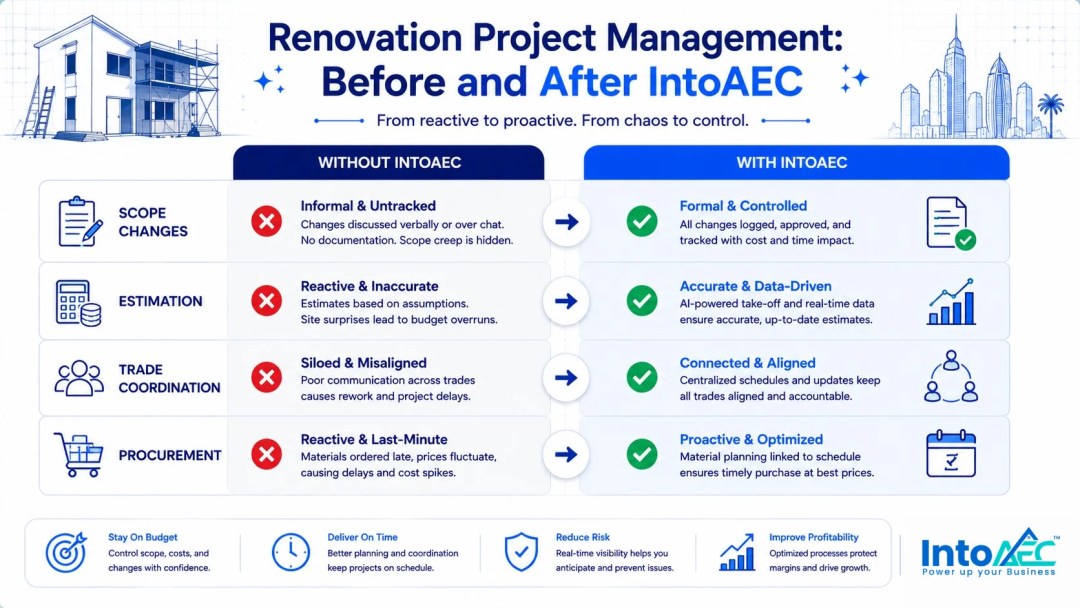
Cause 1: Scope agreed verbally, approved informally
The client agrees to scope changes verbally, and approval stays informal. For example, the client might ask for an extra power point here, or a changed tile specification there. Sometimes it’s a revision to the kitchen layout that “shouldn’t cost much.” At best, someone logs each of these in a WhatsApp message; at worst, no one records it at all. Months later, at final account, the contractor tries to recover costs against an original contract price that nobody amended properly. Meanwhile, the client disputes charges they don’t remember approving.
Cause 2: The estimate doesn’t survive site conditions
The estimate doesn’t survive first contact with the site. Renovation estimating is inherently uncertain because existing conditions are unknown until demolition begins. A contractor who priced a bathroom renovation against assumed slab depth is suddenly dealing with a structural beam nobody expected. The estimate was accurate based on the information available; the site was not. As a result, without a fast mechanism to revise the estimate, capture the variation and get client sign-off, the contractor either absorbs this cost or ends up disputing it with the client.
Cause 3: Trade sequencing breaks down without visibility
Trade sequencing breaks down without visibility. Renovation work is almost always serial. The structural work must precede the MEP rough-in, then the boarding, then the skimming, then the tiling. When one trade slips, the knock-on effect is immediate. Without a shared schedule that shows every trade’s dependency, a site manager managing by phone can’t see the cascade until it’s already happened.
Cause 4: Reactive material procurement
Material procurement happens reactively. Contractors often order long-lead items — custom tiles, kitchen units, specialist MEP equipment — only when someone notices they’re needed. Instead, the programme should set the order date. The result is a finished first fix waiting for a vanity that’s six weeks away. Reactive procurement turns avoidable delays into actual ones.

What renovation project management actually needs to look like
The fundamentals of renovation project management are straightforward. Estimate accurately, track scope changes formally, coordinate trades against a shared programme, and procure materials ahead of when they’re needed. However, the difficulty isn’t knowing what to do — it’s having systems that make doing it less time-consuming than not doing it.
A site manager on a five-bathroom villa renovation cannot spend four hours a day on administrative tasks. The tools need to work with the way renovation jobs actually run, not require the project to adapt to the tool.
How IntoAEC fixes renovation project management
Renovation project management: estimation from scope, not just drawings
Renovation estimating often starts before full drawings exist. It might begin from a client brief, a measured survey, or a scope description rather than a complete drawing set. Estimate Write with AI lets a renovating contractor describe the scope in plain language. It then generates a structured estimate with line items, materials, quantities and rates as a starting point for review. When the scope changes during works, the estimate can be updated directly without rebuilding it from scratch.
A centralised cost catalog for consistent pricing
IntoAEC’s Cost Catalog (released August 14th) lets contractors build and manage a centralised library of materials, services, equipment and assemblies with consistent codes and pricing. This is especially useful for a renovation business running multiple concurrent jobs: keeping material rates consistent across all projects without manually checking each estimate is a real operational saving.
Formal scope change management
This is where renovation contractors recover margin — or lose it. IntoAEC’s Change Order feature captures each scope change, applies the cost impact to the estimate, and routes it to the client for sign-off with a digital signature. IntoAEC timestamps and stores the approval trail against the project. So when the final account conversation happens, the contractor has a complete record of every change raised, what it cost, and when the client signed it off. A documented, signed record now replaces the informal WhatsApp approval that used to become a disputed invoice six weeks later.
Shared scheduling with trade visibility
Schedule Write with Zyra AI generates a schedule template from a project brief, giving the contractor a structured starting point rather than a blank Gantt. The project manager adjusts it to the specific site conditions and trade sequencing. From there, the whole team works from a live schedule that everyone can see, rather than a programme that lives only on the site manager’s laptop. The Vendor Portal lets subcontractors update their own task completion status directly, so the site manager sees progress from all trades in one view rather than managing separate phone calls per trade per day.
Procurement ahead of programme
With the BOQ connected to the procurement module, the team can raise material orders against specific line items when the programme dictates it. This is better than waiting until someone notices the site needs them. This closes the reactive procurement gap: the gap between when material should have been ordered and when it actually was ordered. That gap is what turns a flooring delay into a programme delay.
Real-time visibility for renovation project management
The Project-Wise Dashboard (August 21st) gives the site manager and project manager a live view of each project’s status, key activities and schedule. The Project Health & Zyra Insights feature (released today, August 28th) surfaces project health information and actionable insights in one place. As a result, both team members and clients get a current picture of where the project stands, instead of waiting for a Friday afternoon summary.
What does this mean for UAE renovation contractors specifically?
The UAE renovation and fit-out market carries a specific set of pressures that make renovation project management more demanding than in most markets.
In Dubai, villa and apartment renovations involving structural changes require Dubai Municipality permits and NOCs from relevant authorities. Any change to permitted works requires a formal amendment. That means a scope change on site isn’t just a financial matter — it can also be a regulatory one. The Change Order workflow that captures and routes every scope change for formal sign-off also provides the documentation trail that municipality compliance sometimes requires.
Commercial fit-out projects in DIFC, Business Bay and Downtown Dubai often run against landlord handover dates with penalties for delayed completion. Trade sequencing breakdowns and reactive procurement are not minor inconveniences on these projects — they’re the difference between completing on time and losing margin to liquidated damages. Having a live schedule that all trades can see, with procurement connected to the programme, closes the most common routes to those delays.
Finally, renovation clients in the UAE tend to be highly engaged with their projects. Regular, structured reporting — enabled by IntoAEC’s Client Report module and Daily Report module — keeps clients informed without requiring the project manager to compile updates manually. An informed client is less likely to raise informal requests that become undocumented scope changes, and more likely to trust the contractor’s management of the project.
Conclusion
Renovation projects run over budget for reasons that are largely preventable. The work itself isn’t inherently unmanageable. Instead, the problem lies in the tools. The management tools most renovation contractors use — spreadsheets, WhatsApp, email — aren’t built for the pace and complexity of live renovation works. IntoAEC addresses the four common causes of budget overrun directly: through AI-assisted estimation, formal change order management, connected scheduling and procurement, and real-time project visibility. The margin that disappears on most renovation jobs doesn’t have to.
See how IntoAEC works for renovation contractors in the UAE.

Frequently Asked Questions
Renovation project management is the process of planning, estimating, coordinating and controlling a renovation or fit-out project — covering scope, budget, schedule, trade sequencing and client communication — from initial estimate through to final account.
The most common causes are informal scope approvals with no formal change order process, estimates that couldn’t account for unknown existing conditions, trade sequencing breakdowns, and reactive material procurement that causes programme delays.
Fit-out project management refers to the management of interior fit-out works — particularly in commercial settings such as offices, retail units and hospitality spaces. In the UAE, fit-out is the standard term for renovation of commercial premises and is governed by landlord handover conditions and Dubai Municipality approvals.
AI helps renovation project management by generating estimates from plain-language scope descriptions, producing schedule templates from project briefs, and surfacing project health insights that would otherwise require manual data assembly. The most immediate value is in the time it saves on tasks that would otherwise be done manually per project.
IntoAEC offers AI-assisted estimation (Estimate Write with AI), 2D takeoff with Zyra AI, schedule generation (Schedule Write with Zyra AI), formal change order management with client sign-off, a Cost Catalog for consistent material pricing, a Vendor Portal for subcontractor coordination, daily reporting, client reporting and project health visibility through the Project-Wise Dashboard and Zyra Insights.