

Table of Contents
Two contractors price the same drawings and come back twenty per cent apart. Neither is cheating. They simply measured the job differently. That gap is where thin margins, disputes and lost tenders begin, and it is exactly what a Bill of Quantities exists to close. In practice, BOQ in construction turns a set of drawings into one priceable list that every bidder works from. Get it right and your tender is clear, comparable and defensible. Get it wrong and the errors follow you from bid to final account. This guide covers what BOQ in construction means, its types and components, how you prepare it, and how modern BOQ software keeps it accurate.
What Is BOQ in Construction? (Bill of Quantities Explained)
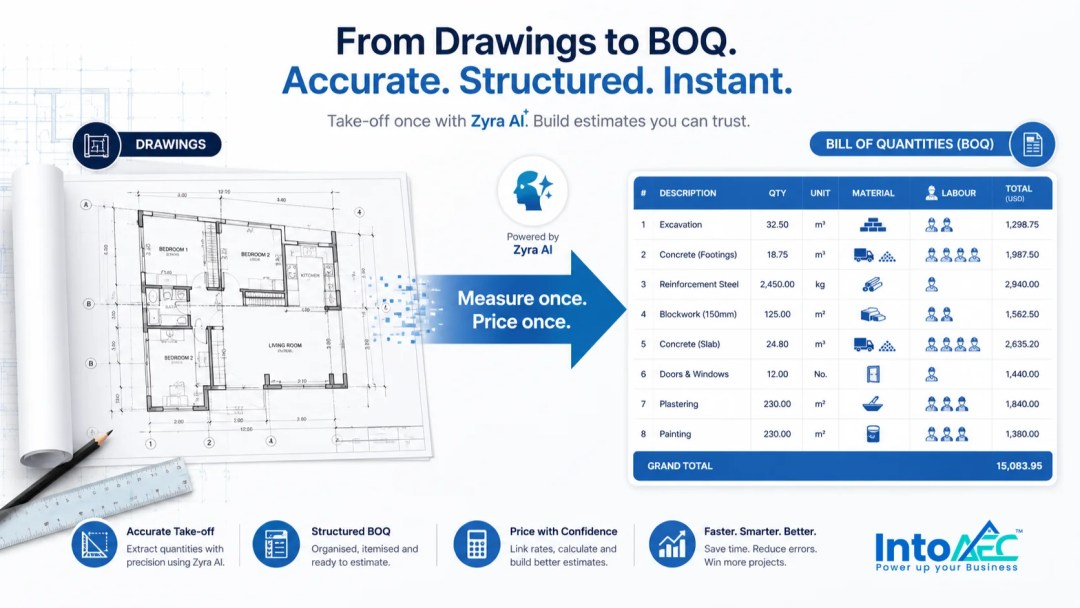
A Bill of Quantities is a measured, itemised list of everything a project needs, structured so that every tenderer prices exactly the same scope. It translates drawings and specifications into a priceable schedule. Specifically, each line describes an item of work, states its quantity and unit of measurement, and leaves a column for the contractor’s rate. Therefore every bidder prices the same defined scope. As a result, the client can compare tenders on a like-for-like basis, and the winning contractor has a clear cost plan to build against. In short, the BOQ is the single source of truth that keeps estimating, procurement and cost control aligned.
What does BOQ stand for?
Simply put, BOQ stands for Bill of Quantities. You will also see it written as B.O.Q., or in the plural as BOQs. People sometimes call it a bill of quantity, however the correct term is Bill of Quantities because it captures the quantities of many different items across the whole works. For a short, standalone answer to this exact question, see our companion post on the BOQ full form.
What Does a BOQ Include?
A complete BOQ is far more than a list of materials. Because each section closes a specific risk, a strong BOQ contains all of the following:
- Preliminaries. Project-wide costs such as site set-up, supervision, temporary works and insurances.
- Preambles. Notes that define how you measure items and what each rate includes.
- Measured works. For example, the priced items of permanent work, grouped by trade or building element.
- Provisional sums. Allowances for work that teams foresee but have not yet fully designed.
- Prime cost (PC) sums. Allowances for materials or specialist work from nominated suppliers.
- Dayworks schedule. For example, agreed rates for work carried out on a time-and-materials basis.
- Contingency sum. For instance, a stated allowance held for the unforeseen.
- Summary. Where every section total rolls up into the tender figure.

What are the main types of BOQ?
Overall, the two most common forms are the firm (detailed) BOQ and the approximate (provisional) BOQ. You measure a firm BOQ from complete drawings and use it for competitive tendering. In contrast, you measure an approximate or provisional BOQ from partial information for an early budget, then re-measure it later. You will also meet elemental BOQs (grouped by building element), trade BOQs (grouped by trade) and itemised BOQs (each item measured separately).
BOQ vs BOM vs cost estimate: what is the difference?
In essence, a BOQ measures work and quantities for pricing a tender, a Bill of Materials (BOM) lists only materials for procurement, and a cost estimate is the priced output. They are related, yet they are not interchangeable. Treating a BOM as a BOQ leaves out labour, plant and preliminaries. You cannot audit a cost estimate without a BOQ behind it, line by line. The table below sets them apart.
| Document | What it lists | Main use |
| Bill of Quantities (BOQ) | Work items, quantities and units across all trades | Pricing tenders, comparing bids, cost control |
| Bill of Materials (BOM) | Materials and components only | Procurement and ordering |
| Cost estimate | Priced totals derived from the BOQ | Budgeting and the tender figure |

How is a BOQ prepared, step by step?
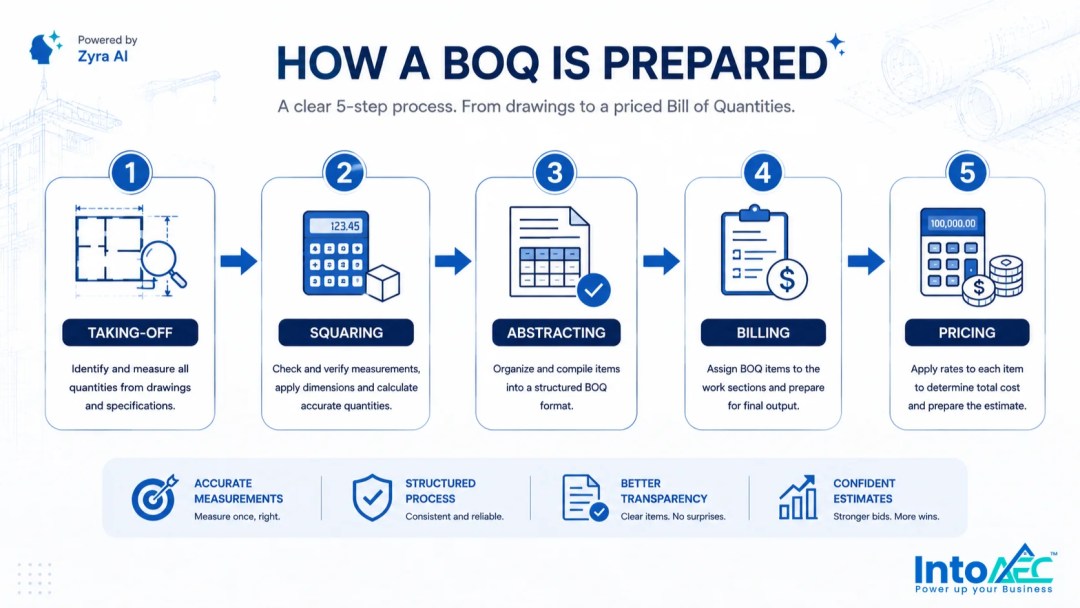
Generally, preparing a BOQ follows a set sequence, traditionally taking-off, squaring, abstracting, billing and pricing. Each step is a point where a manual error can enter and then spread into every downstream number, so discipline matters.
- Taking-off. Measure quantities from the drawings against a method of measurement such as POMI, RICS NRM2 or a local standard.
- Squaring. Calculate those measurements into final quantities.
- Abstracting. Sort and collect the quantities under the right headings.
- Billing. Write the items up in the standard bill format, with clear descriptions and units.
- Pricing. Apply rates to each item, so the totals build up to the tender figure.
How Is BOQ in Construction Used Across Different Markets?
A BOQ is shaped by the contract and measurement standard of its market, even though its core purpose does not change. In the UAE, BOQs sit under FIDIC Red Book contracts, where remeasurement and Clause 13 variations make an accurate bill essential to valuing change. The United Kingdom’s quantity surveyors prepare BOQs to RICS NRM2 for traditional procurement. In South Africa, BOQs follow the ASAQS standard system and support JBCC tender evaluation. In Australia, BOQs work alongside estimates under AS 4000 to keep scope and cost transparent. The standards differ, yet the purpose is the same everywhere.
What Are the Most Common Mistakes with BOQ in Construction?
Typically, the costliest mistakes come from stale drawings, missing sections and inconsistent units. Most BOQ errors are quiet, not dramatic, which is why they reach the final account before anyone notices. Watch for these:
- Measuring from superseded drawings, so quantities no longer match the design.
- Omitting preliminaries, or under-pricing them, which erodes margin.
- Inconsistent units, or double-counting between trades.
- No clear provisional or contingency sums, so change has nowhere to land.
How Does BOQ Software Improve Accuracy in Construction?
Ultimately, BOQ software removes the manual take-off, squaring and re-measurement steps where errors and lost hours build up. Instead of measuring by hand and re-keying figures across spreadsheets, you measure once on the drawing and the quantities flow into a structured, priceable bill. When the design changes, the affected quantities update rather than forcing a full re-measure. With IntoAEC, the BOQ is connected: 2d take off feeds the BOQ, the BOQ feeds your Estimates and Procurement, and Zyra AI handles the repetitive measuring and formatting. You do not interact with the AI. You just stop doing the work it handles.
Conclusion
The Bill of Quantities remains the backbone of construction cost planning, but the way it is prepared has moved on. As a result, moving from spreadsheets to a connected digital BOQ improves accuracy, speed and visibility across the project. Above all, it gives your quantity surveyors time for judgement instead of data entry. Ready to see it in practice?
See how IntoAEC builds an error-free BOQ from your drawings.

Frequently asked questions
BOQ in construction means Bill of Quantities: a structured document listing all the work, materials and quantities needed for a project, so it can be priced consistently and audited line by line.
BOQ stands for Bill of Quantities. It is sometimes written as B.O.Q. or, in the plural, BOQs.
Generally, a quantity surveyor usually prepares the BOQ from the drawings and specifications. In addition, contractors and estimators build and price them.
In short, the BOQ measures and structures the scope. In turn, the estimate is what you get once each BOQ item is priced with rates.
Yes. In fact, BOQ software such as IntoAEC lets you build a structured bill straight from your take-off, then link it to your estimates and procurement so nothing is re-keyed.