

Table of contents
- Table of contents
- What does RFIs meaning actually refer to?
- Why do RFIs matter so much on Australian construction projects?
- How does RFI software improve response times?
- How IntoAEC helps construction teams manage RFIs
- Conclusion
- Frequently asked questions
- Related articles
Every construction project reaches a point where somebody needs clarification before work can continue.
The structural drawings show one dimension while the architectural drawings show another. A subcontractor needs confirmation about a material specification. A site engineer discovers that the existing conditions do not match the approved design.
At that point, the project team raises an RFI.
Understanding RFIs meaning is straightforward. Managing RFIs efficiently is where projects succeed or fall behind.
Across Australian construction projects, delayed RFIs are one of the biggest hidden causes of programme overruns. A simple clarification that should take a few hours often sits unanswered for several days. While everyone waits for a response, labour stands idle, subcontractors move onto other work and schedules begin slipping.
The problem is rarely the RFI itself.
Instead, delays usually happen because the request lacks enough information, reaches the wrong person, or disappears inside long email chains where nobody knows who owns the next action.
This guide explains what RFIs mean in construction and shares six practical rules used by successful Australian contractors to receive faster, clearer responses while keeping complete documentation for future reference.
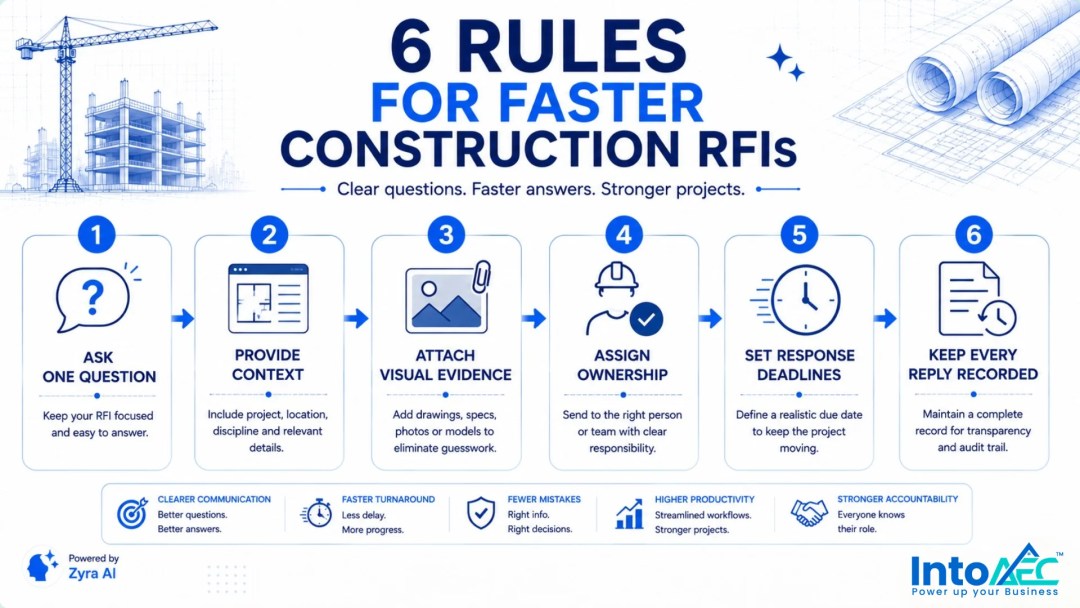
Quick summary: the 6 rules at a glance
- Rule 1: Ask only one question per RFI
- Rule 2: Always provide complete context
- Rule 3: Include visual evidence
- Rule 4: Assign ownership immediately
- Rule 5: Define response deadlines
- Rule 6: Maintain a complete audit trail
What does RFIs meaning actually refer to?
RFI stands for Request for Information.
It is the formal communication process used whenever someone working on a project requires clarification before continuing work.
An RFI is not intended to redesign a project.
It is also not a variation request or an instruction to perform additional work.
Instead, it asks a specific question so that everyone involved can proceed using the same understanding.
For example:
A contractor notices that two drawing sheets specify different ceiling heights.
Rather than making assumptions, the contractor submits an RFI asking which dimension should be followed.
The architect reviews the documents, confirms the correct measurement and issues a formal response.
The project then continues using the approved clarification.
Without the RFI, different trades might build according to different interpretations, creating costly rework later.
Why do RFIs matter so much on Australian construction projects?
Australian construction projects often involve numerous stakeholders working simultaneously.
These include:
- Architects
- Structural engineers
- Mechanical consultants
- Electrical consultants
- Hydraulic consultants
- Quantity surveyors
- Principal contractors
- Specialist subcontractors
- Project managers
- Clients
Every stakeholder produces documentation that influences construction activities.
Even with careful coordination, inconsistencies occasionally appear between drawings, specifications and site conditions.
RFIs provide the structured process for resolving these inconsistencies before work continues.
Without RFIs, teams often rely on verbal conversations or email threads that are difficult to track later.
When disputes arise during project close-out, undocumented decisions become impossible to verify.
Proper RFI management creates a permanent record showing:
- who asked the question,
- why clarification was needed,
- who approved the response,
- when the decision was made, and
- how the issue was resolved.
This documentation becomes invaluable when managing claims, extensions of time and contract administration.
Rule 1: Ask only one question per RFI
One of the biggest reasons RFIs remain unanswered is because they contain too many unrelated questions.
A single RFI asking about structural steel, waterproofing details, electrical conduits and ceiling finishes forces multiple consultants to become involved before anyone can respond.
Instead, every RFI should focus on one specific issue.
For example:
Poor RFI
Please clarify all structural, architectural and electrical discrepancies on Level 3.
This request is too broad.
No consultant knows exactly what should be answered first.
A better approach would be:
Drawing S-304 specifies a 300 mm beam depth, while drawing A-205 shows 350 mm at Grid C4. Please confirm the correct beam depth before concrete reinforcement is installed.
The second request is:
- precise,
- measurable,
- easy to understand,
- immediately assignable.
Consultants can respond much faster because the scope of the request is clearly defined.
Projects processing hundreds of RFIs benefit significantly from this approach because every question becomes searchable and easier to track later.
Rule 2: Always provide complete context
An RFI without supporting information creates another question instead of providing an answer.
Every RFI should contain enough context that the reviewer understands the issue without searching through dozens of project documents.
Include:
- Drawing number
- Revision number
- Specification reference
- Exact location
- Relevant dimensions
- Trade affected
- Description of site conditions
Instead of writing:
Door size appears incorrect.
Provide something like:
Door D-204 on Drawing A-510 Revision C shows a width of 920 mm, while Schedule S-11 specifies 870 mm. Please confirm the approved door width before procurement.
The consultant immediately understands the issue and can issue a response without requesting additional clarification.
Rule 3: Include visual evidence
Construction is visual.
Many RFIs become significantly easier to understand when accompanied by supporting imagery.
Useful attachments include:
- Site photographs
- Drone imagery
- PDF mark-ups
- Screenshot annotations
- BIM model captures
- Redline drawings
For example, a photograph showing a clash between ductwork and structural beams communicates the issue far more effectively than several paragraphs of text.
Visual evidence reduces misunderstanding, accelerates consultant review and helps maintain an accurate project record.
It also becomes valuable months later if the same issue is referenced during contract administration or dispute resolution.
Rule 4: Assign ownership immediately
Even a perfectly written RFI can become a bottleneck if nobody is responsible for answering it.
One of the most common reasons RFIs remain open for weeks is that they are sent to a general project email or shared with multiple stakeholders without a clear owner. When everyone receives the request, everyone assumes someone else will respond.
Every RFI should have:
- A single responsible reviewer
- Supporting reviewers (if required)
- A due date
- A current status
- A priority level
For example:
| Field | Example |
|---|---|
| Assigned To | Lead Structural Engineer |
| Supporting Review | Project Architect |
| Priority | High |
| Status | Awaiting Response |
| Due Date | 14 August 2026 |
This simple ownership model eliminates uncertainty and makes accountability visible across the project team.
For larger Australian commercial projects involving multiple consultants, assigning ownership also helps project managers identify approval bottlenecks before they begin affecting construction activities.
Instead of chasing updates through emails and phone calls, the project team can immediately see:
- Who owns the RFI
- How long it has been outstanding
- Which consultant is delaying the response
- Which trades are affected by the pending clarification
The result is significantly faster decision-making and fewer programme disruptions.
Rule 5: Define response deadlines
Not every RFI has the same urgency.
A clarification relating to finishes that will not be installed for another three months does not require the same response time as a structural query delaying tomorrow’s concrete pour.
Projects become more efficient when RFIs are prioritised according to construction activities.
A practical approach is to classify RFIs into three categories:
Critical (24–48 hours)
These RFIs block construction activities that are already underway.
Examples include:
- Structural discrepancies
- Safety-related clarifications
- Services clashes preventing installation
- Concrete reinforcement queries
Standard (3–5 working days)
These cover routine design clarifications that do not immediately stop work.
Examples include:
- Internal finish selections
- Material substitutions
- Minor specification confirmations
Future Planning (5–10 working days)
These relate to work scheduled further into the programme.
Examples include:
- Landscape details
- Future procurement decisions
- Long-lead equipment approvals
Establishing expected response times benefits everyone involved.
Contractors can plan resources more effectively.
Consultants understand project priorities.
Clients receive greater confidence that issues are being actively managed rather than discovered too late.
Many Australian contractors now include RFI response times directly within their project execution plans to improve communication expectations from the outset.
Rule 6: Maintain a complete audit trail
The value of an RFI extends far beyond receiving an answer.
Months later, during project close-out or contract administration, project teams often need to revisit decisions that were made earlier in construction.
If responses are scattered across email conversations, phone calls and handwritten notes, verifying the approved instruction becomes difficult.
Every RFI should maintain a complete history, including:
- Original request
- Supporting attachments
- All reviewer comments
- Approved response
- Revision history
- Dates and timestamps
- Linked drawings
- Related variations (if applicable)
For example:
A contractor installs additional reinforcement after receiving clarification through an RFI.
Six months later, the client questions the additional cost.
Instead of searching hundreds of emails, the contractor can produce the complete RFI history showing:
- The original design discrepancy
- Consultant clarification
- Approval date
- Revised drawing
- Site implementation
The issue is resolved within minutes because every decision has been documented.
A complete audit trail protects every stakeholder and significantly reduces disputes during final account negotiations.
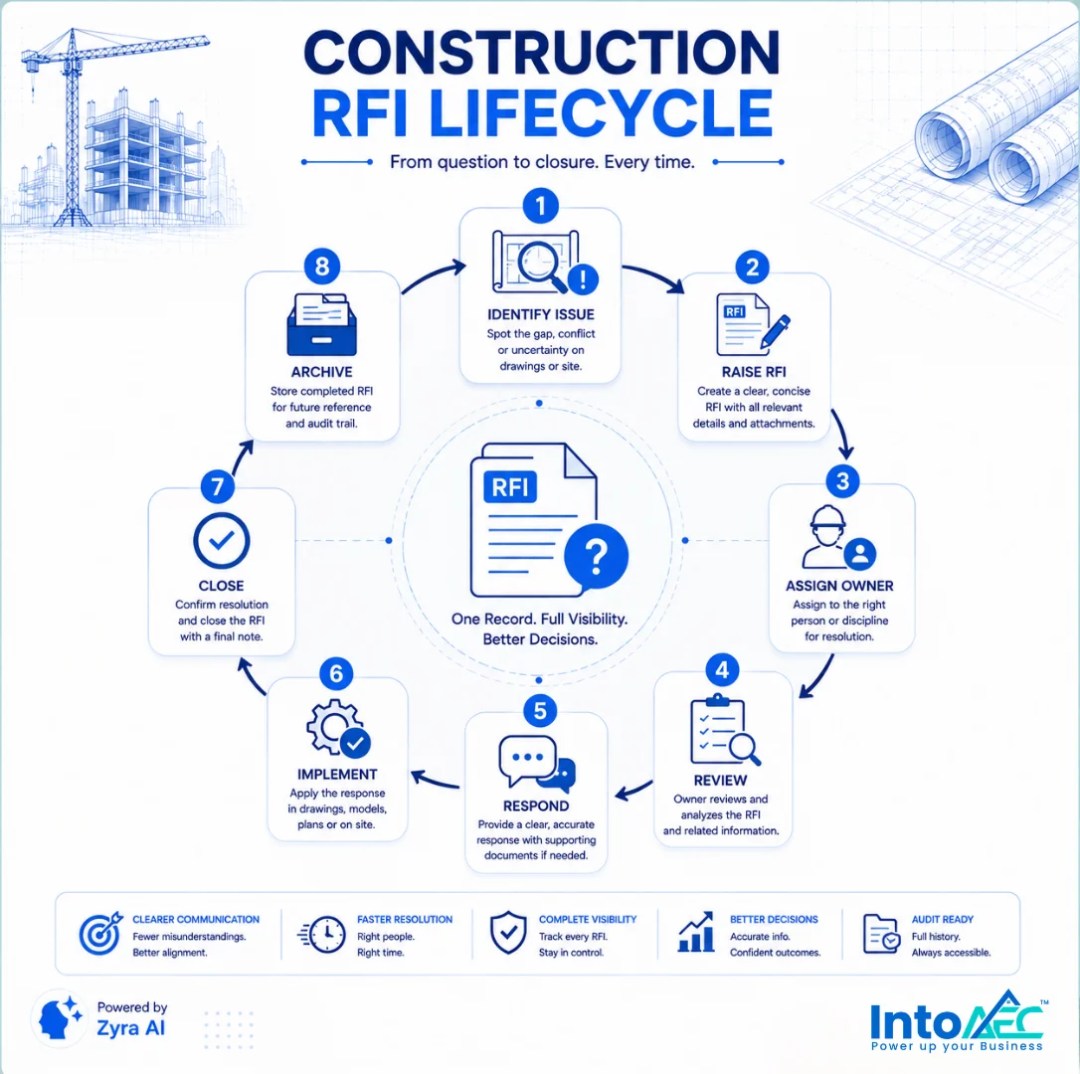
How does RFI software improve response times?
Many construction companies still manage RFIs using spreadsheets, shared folders and long email chains.
While this may work on smaller projects, it quickly becomes difficult to manage as project complexity increases.
Modern construction management software centralises the entire RFI process within a single platform.
Instead of manually searching through emails, project teams can:
- Raise RFIs directly from project drawings
- Attach photographs and annotated PDFs
- Assign owners automatically
- Track response deadlines
- Receive notifications when responses are overdue
- Link RFIs to drawings, tasks and variations
- Maintain a searchable project history
This structured workflow reduces administrative effort while improving visibility across every stakeholder.
How IntoAEC helps construction teams manage RFIs
Construction projects generate hundreds of decisions every month.
Without a structured workflow, valuable information becomes fragmented across multiple communication channels.
IntoAEC brings RFI management into a single connected project environment.
Project teams can:
- Create RFIs directly from project documents
- Attach site photos, drawings and annotations
- Assign consultants and responsible reviewers
- Track response deadlines automatically
- Link RFIs to tasks, schedules and document revisions
- Maintain a complete audit trail throughout the project lifecycle
When RFIs are connected with project schedules and documentation, teams spend less time searching for information and more time progressing construction activities.
IntoAEC also leverages Zyra AI to assist with repetitive administrative work such as organising project documentation, identifying related records and streamlining information retrieval. Project professionals remain fully in control of technical decisions while Zyra AI handles routine administrative processes behind the scenes.
You do not interact with the AI.
You simply spend less time managing paperwork and more time delivering projects.
Conclusion
Understanding RFIs meaning is only the first step. The real value comes from managing Requests for Information in a way that keeps projects moving instead of creating delays.
Across Australian construction projects, RFIs are raised every day to clarify drawings, specifications, existing site conditions and contract requirements. When handled properly, they reduce uncertainty, improve collaboration and create a documented record that protects every stakeholder. When managed poorly, they become one of the leading causes of programme delays, rework and contractual disputes.
The six rules outlined in this guide provide a simple framework that every project team can adopt:
- Ask one question per RFI.
- Provide complete project context.
- Support requests with visual evidence.
- Assign clear ownership.
- Set realistic response deadlines.
- Maintain a complete audit trail.
These practices help consultants respond faster, enable contractors to keep work progressing and ensure every clarification is recorded for future reference.
As projects become more complex, relying on email threads and spreadsheets becomes increasingly difficult. A dedicated construction management platform ensures every RFI is linked to the relevant drawings, documents, schedules and project records, giving teams complete visibility from the first question through to project completion.
Want to streamline your RFI process and improve project communication?
See how IntoAEC helps construction teams manage RFIs, documents, schedules and project workflows from a single platform.

Frequently asked questions
An RFI (Request for Information) is a formal document used during construction to request clarification whenever drawings, specifications or contract documents are unclear. It helps ensure that contractors, consultants and clients work from the same understanding before construction proceeds.
An RFI should be submitted whenever project documentation contains conflicting information, missing details or unclear instructions that could affect construction quality, safety, cost or programme. Raising an RFI early prevents assumptions and reduces the risk of rework.
The responsible reviewer depends on the nature of the query. Responses are typically provided by architects, engineers, consultants or the client’s representative. Every RFI should have a clearly assigned owner and an agreed response timeframe to avoid unnecessary delays.
A well-prepared RFI should contain:
Project name
RFI reference number
Description of the issue
Drawing and specification references
Site location
Supporting photographs or mark-ups
Requested clarification
Priority level
Required response date
Providing complete information enables consultants to respond more quickly and accurately.
Construction management software centralises the RFI process by allowing project teams to create, assign, monitor and archive RFIs within a single platform. This improves accountability, reduces response times, maintains a complete audit trail and ensures every clarification remains linked to the relevant project documentation.
Related articles
- Construction Project Management Software Australia
- Why Contractors Lose Money for Poor Project Coordination (and How to Fix It)
- Construction Scheduling Software for General Contractors
- The Real Cost of Chaos: Why Traditional Tools Fail Construction Project Management
- Hours Lost to Document Hunting and Endless Review Cycles? How IntoAEC Organises Drawings, Approvals and Project Handover Records