

Table of Contents
A project can be priced correctly, staffed correctly, and still bleed margin, not because the work was wrong, but because nobody was working from the same numbers. A site manager working off yesterday’s drawing revision. A quantity surveyor unaware of a variation the PM verbally approved on site. An invoice raised against a budget line that was quietly reallocated three weeks ago. None of these are dramatic failures. They are small coordination gaps, and on a South African site running to NHBRC and JBCC obligations, small gaps compound fast. This guide breaks down exactly where contractors lose money to poor coordination, and what fixing it actually looks like in practice.

Where does poor project coordination actually cost contractors money?
Poor coordination costs money in four repeatable places, not in one dramatic failure. Each one is small enough to go unnoticed on its own, and expensive enough in aggregate to erode a project’s margin by the time it reaches final account.
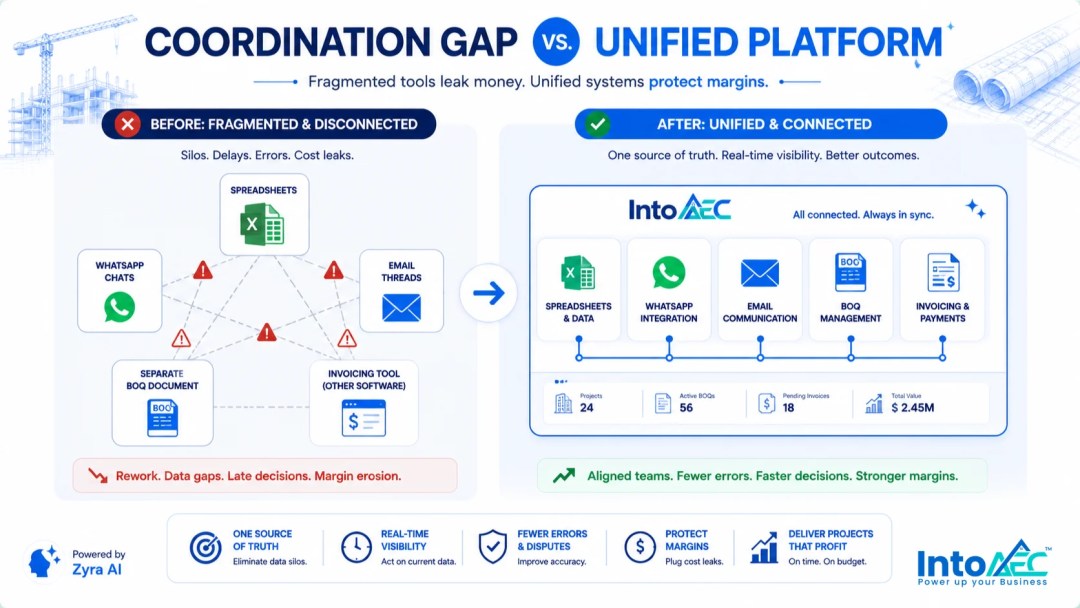
1. Disconnected cost and schedule data. When the programme lives in one tool, the budget in a spreadsheet, and the BOQ in a separate document, nobody has a single live view of where the project actually stands. A delay on site does not automatically show its cost impact, so by the time someone connects the two, the exposure has already grown.
2. Unlogged or verbally approved variations. A site instruction given verbally, or agreed over WhatsApp, has no audit trail and no automatic link to cost. Weeks later, when the invoice or the final account comes through, there is a dispute about what was actually approved and by whom. In South Africa, where JBCC contracts require variations to be properly instructed and valued, an unlogged verbal approval is a real financial and contractual risk, not just an inconvenience.
3. Delayed site-to-office reporting. If daily progress, delays and site issues reach the project manager’s desk two or three days late, decisions get made on stale information. A resourcing problem that could have been caught on day one gets caught on day four, after the cost has already been incurred.
4. Manual reconciliation between BOQ, procurement and invoicing. When these three live in separate systems, someone has to manually check that what was ordered matches what was billed against the BOQ. This is slow, and it is exactly the kind of repetitive cross-checking where human error creeps in, usually in the contractor’s favour on paper and against their margin in reality.
Why does this hit South African contractors particularly hard?
South African contracts add structure that punishes poor coordination specifically. Under JBCC, variations must be properly instructed and valued, so an informal WhatsApp approval with no record is a genuine contractual exposure, not just bad practice. NHBRC obligations on residential work mean defects and remedial costs need a clear, traceable history, which a fragmented paper trail cannot provide when a dispute arises. And CIDB grading reviews look at a contractor’s project delivery track record, so repeated cost overruns from coordination failures do not just hurt one project’s margin, they can affect future tender eligibility.
What does “unifying coordination, cost and site data” actually look like?
It looks like every stakeholder working from the same live numbers instead of reconciling separate ones after the fact. A site instruction gets logged against the project the moment it happens, with photo evidence and a clear approval trail. That instruction automatically flags its cost impact against the BOQ, instead of waiting for someone to notice at invoicing stage. Daily site progress reaches the project manager the same day, not three days later. And when it is time to invoice, the numbers already reconcile, because procurement, the BOQ and invoicing were never separate systems to begin with.
How does IntoAEC fix this for contractors and PMs?
IntoAEC fixes this by connecting the workflow instead of leaving contractors to connect it manually after the fact. Site coordination, Scheduling, BoQ, Procurement and invoicing sit on one platform, so a variation logged on site updates the cost picture immediately, not at the next reconciliation cycle. The customer portal gives clients and PMs the same live view, which cuts down on the “what was actually approved” disputes that JBCC variations are prone to. Zyra AI handles the repetitive logging and reformatting behind the scenes, so your PMs spend their time managing the project instead of chasing paperwork across five different tools. You do not interact with the AI. You just stop doing the work it handles.
Conclusion
None of the four ways contractors lose money to poor coordination look dramatic in the moment. A verbal approval here, a delayed report there, a manual reconciliation that takes an extra hour. But on a South African project running to JBCC and NHBRC obligations, these small gaps are exactly where margin quietly disappears, and exactly what a properly connected platform closes. Want to see what a unified view of your project actually looks like?
See how IntoAEC connects coordination, cost and site data on one platform.

Frequently asked questions
Because the loss usually comes from coordination gaps after pricing, not from the price itself: disconnected cost and schedule data, unlogged variations, delayed reporting and manual reconciliation between systems.
JBCC contracts require variations to be properly instructed and valued. A verbal or WhatsApp approval with no record leaves both parties exposed to a dispute about what was actually agreed.
When progress and issues reach the project manager days late, decisions get made on outdated information, so problems that could have been caught early get caught after the cost is already incurred.
It means site instructions, the BOQ, procurement and invoicing all update from the same live data, so nobody is manually reconciling separate systems after the fact.
Yes, indirectly. CIDB grading reviews look at project delivery track record, so repeated cost overruns from coordination failures can affect future tender eligibility, not just current project margin.