

Table of Contents
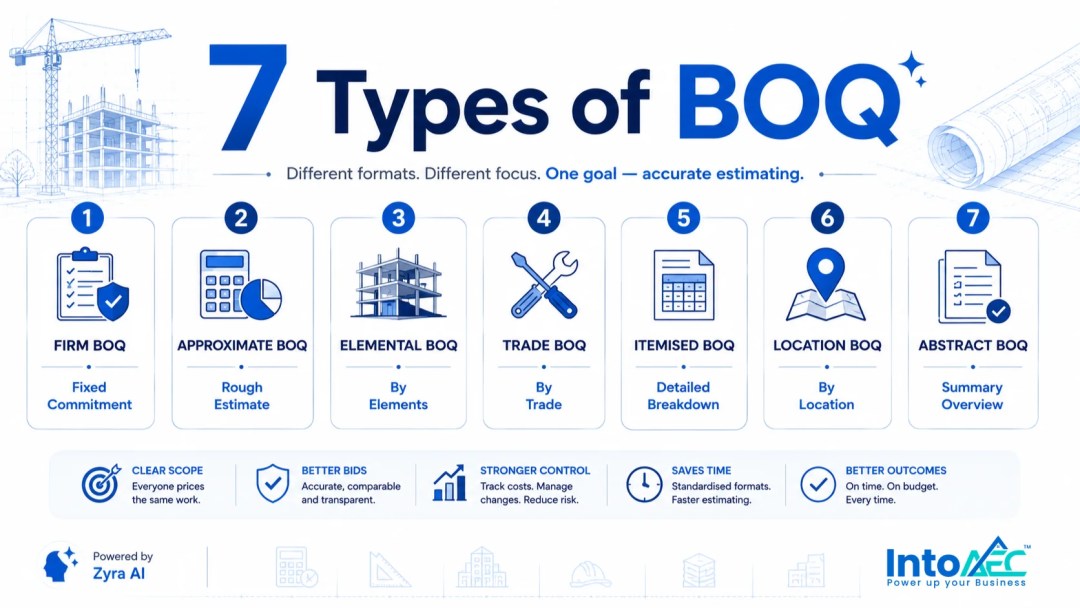
Reach for the wrong Bill of Quantities at the wrong stage, and your pricing is off before you enter a single rate. The version you prepare for an early budget is nothing like the one you issue to bidders. So knowing the types of BOQ, and when each earns its place, is basic estimator hygiene. Below are the seven you will actually meet on live projects, with a plain definition, when to use each, a quick example, and the mistake to avoid. There is a comparison table further down, plus guidance on choosing by project stage.
What is a Bill of Quantities? A quick recap
A Bill of Quantities is a measured, itemised list of the work, materials and quantities needed to complete a project. Before the types, a one-line reminder helps. It sets the scope for a project so every contractor prices the same work. The ‘type’ simply describes how complete the measurement is and how the bill is organised. For the full definition, components and process, see our complete BOQ guide. For an independent glossary definition, see this Bill of Quantities overview from Designing Buildings.
What are the 7 types of BOQ?
1. Firm (Detailed) BOQ.
Measured precisely from complete drawings and a chosen method of measurement, so the quantities are fixed. Use it for competitive tendering, where every bidder must price the same defined scope. Example: a fully designed office fit-out going out to five contractors. Watch-out: it needs complete drawings, so it is not suitable early in design.
2. Approximate (Provisional) BOQ.
Measured from partial information to give an early, order-of-magnitude budget, then re-measured as the design develops. Use it for feasibility and early cost advice. Example: a client budget before the design is finalised. Watch-out: never run a competitive tender off an approximate bill, because the quantities will move.
3. Elemental BOQ.
Organised by building element, such as substructure, frame, envelope and services, rather than by trade. Use it for cost planning and for benchmarking against past projects. Example: comparing the frame cost of two similar buildings. Watch-out: it is a planning tool, not usually the format contractors price line by line.
4. Trade BOQ.
Grouped by trade, such as concrete, blockwork, electrical and plumbing. Use it when packaging works to subcontractors, because each trade sees its own scope. Example: sending the electrical package out to specialist subbies. Watch-out: shared items can fall between trades if the split is not clean.
5. Itemised BOQ.
Each work item measured and listed separately with its own description, unit and rate. This is the most common working format on detailed projects. Example: a standard tender bill with hundreds of priced lines. Watch-out: it is only as good as the measurement behind it.
6. Location BOQ.
Split by area, floor or zone, so costs can be tracked by part of the building. Use it on phased or multi-block schemes where you bill by section. Example: a three-tower residential development priced tower by tower. Watch-out: repeated items must be handled consistently across locations.
7. Abstract BOQ.
A summarised roll-up of quantities and costs across the project, used for a high-level view rather than line-by-line pricing. Use it for reporting and quick cost checks. Example: a one-page cost summary for a client meeting. Watch-out: it hides detail, so never tender from an abstract alone.

How do the 7 types of BOQ compare?
Each type maps to a design stage, a best use and a pricing basis. The table sets them side by side so you can pick at a glance.
| Type of BOQ | Design stage | Best for | Pricing basis |
| Firm (Detailed) | Complete design | Competitive tendering | Lump sum from fixed quantities |
| Approximate (Provisional) | Early / partial design | Budgets and feasibility | Re-measurement later |
| Elemental | Design development | Cost planning, benchmarking | Element cost targets |
| Trade | Tender / packaging | Subcontract packages | Rates by trade |
| Itemised | Tender / construction | Detailed pricing | Rate per measured item |
| Location | Phased projects | Tracking cost by area | Rates by zone |
| Abstract | Any / reporting | High-level cost view | Summary totals |
How do the BOQ types differ by pricing?
The biggest practical difference between BOQ types is whether the price is a lump sum or subject to remeasurement. A firm BOQ gives a lump sum, because the quantities are fixed and the contractor prices to a defined scope. An approximate or provisional BOQ is priced on re-measurement, so the final figure is confirmed as the work is built. Understanding this split matters, because it changes how much cost risk sits with the client versus the contractor. In short, fixed quantities move risk to the contractor, while provisional quantities keep it with the client until remeasurement.
Firm vs approximate BOQ: which should you use?
A firm BOQ is more accurate, but an approximate BOQ is more useful early, so the right choice depends on your design stage. Use a firm BOQ when the design is complete and you want reliable, comparable tenders. Use an approximate BOQ when you need an early budget and the design is still moving. The error is not choosing one over the other in principle. It is running a competitive tender off an approximate bill, then arguing about quantities later. Match the bill to the certainty of your design, and the disputes fade.

How do you keep every BOQ type consistent?
Consistency across BOQ types comes from measuring once and reusing that data, not rebuilding the bill each time. Rebuilding a bill by hand for each stage is where quantities drift and versions conflict. With IntoAEC, one measured take-off can produce an approximate bill early and a firm, tender-ready bill later, without re-measuring from scratch. When the design changes, the affected quantities update instead of forcing a full re-count. Your estimators keep control of the rates and the judgement, while the tool handles the measuring and the re-formatting. You do not interact with the AI. You just stop doing the work it handles.
Conclusion
Every one of these seven types of BOQ has a job to do, from the rough approximate bill that shapes a budget to the firm bill that wins the work. Choose by project stage, keep your measurement consistent, and let software carry the repetitive re-work. Want to see one take-off turn into any BOQ type you need?
Produce tender-ready BOQs from a single take-off.

Frequently asked questions
The most common are firm (detailed), approximate (provisional), elemental, trade, itemised, location and abstract Bills of Quantities. They differ by design stage and how the bill is organised.
A firm BOQ is measured from complete drawings and priced as a lump sum for tendering. An approximate BOQ is measured from partial information for an early budget and priced on re-measurement as the design develops.
An elemental BOQ is organised by building element, such as substructure, frame and services, rather than by trade. It is useful for cost planning and benchmarking against similar projects.
A firm, detailed and itemised BOQ is used for competitive tendering, because it defines every quantity so bidders price the same scope.
Yes. With BOQ software, a single measured take-off can generate an approximate bill early and a firm bill later, which keeps quantities consistent across stages.