

Table of contents
Choosing the best BOQ software is no longer just about replacing spreadsheets. For construction firms in the UAE, it is about producing accurate Bills of Quantities faster, reducing estimating errors and delivering competitive tenders without increasing workload.
The construction sector across Dubai, Abu Dhabi and the wider UAE is becoming increasingly data-driven. Contractors are expected to price projects quickly while maintaining accuracy across commercial, residential and infrastructure developments. At the same time, clients expect transparent cost breakdowns, consultants demand detailed documentation and projects frequently operate under FIDIC contracts where accurate Bills of Quantities play a critical role in managing variations.
Traditional spreadsheet-based estimating struggles to keep pace with these demands. Manual quantity take-offs, disconnected drawings and inconsistent templates often lead to missed items, duplicated work and costly revisions.
Modern BOQ software solves these challenges by combining digital take-offs, structured BOQ creation, document management and collaboration within a single workflow.
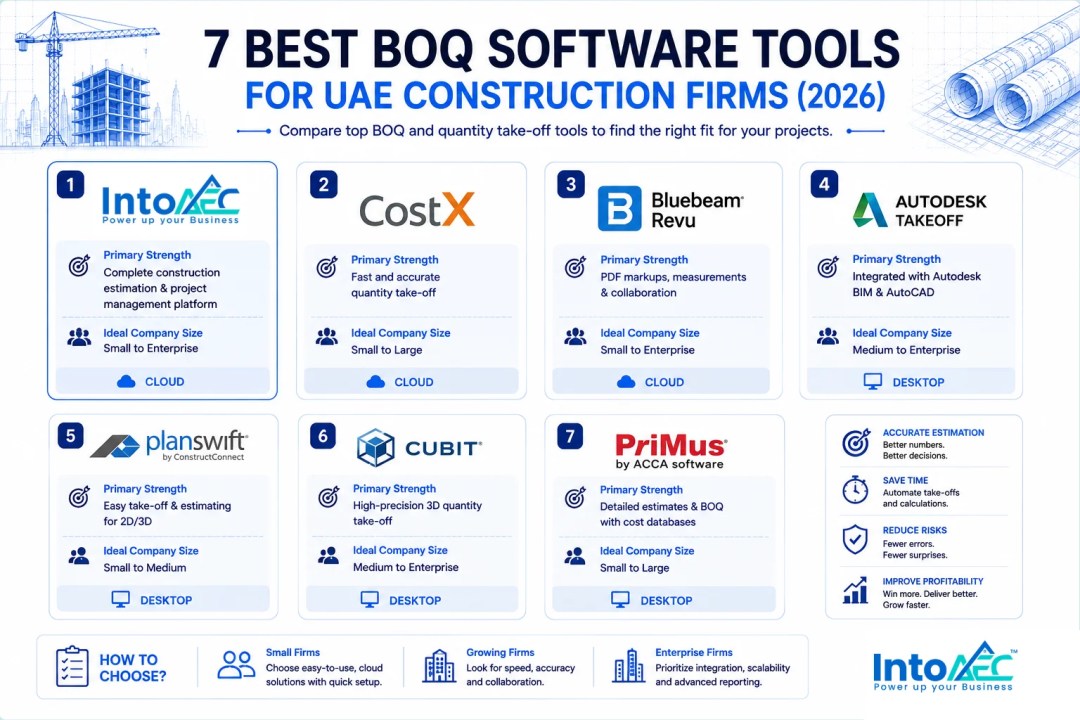
This guide compares seven of the best BOQ software solutions available for UAE construction firms in 2026, highlighting their strengths, ideal users and considerations before selecting the right platform.
Why UAE contractors are moving away from spreadsheets
For many years, spreadsheets have been the default tool for creating Bills of Quantities. While they remain familiar, they introduce significant risks as projects grow in complexity.
Common challenges include:
- Manual quantity calculations
- Version control issues
- Duplicate data entry
- Formula errors
- Limited collaboration
- Difficult revision management
- No direct link between drawings and quantities
On large commercial projects, even a small measurement error can affect procurement budgets, subcontractor pricing and final project profitability.
Digital BOQ software reduces these risks by creating structured workflows where quantities, drawings and cost information remain connected throughout the estimating process.
What should you look for in the best BOQ software?
Not every estimating platform offers the same capabilities.
Before investing, UAE construction firms should evaluate whether the software provides:
- Accurate digital take-offs
- Automated quantity calculations
- Standard BOQ templates
- Revision history
- Cloud collaboration
- Drawing version control
- Cost database integration
- Procurement compatibility
- Project management integration
- Reporting dashboards
Choosing software based solely on price often leads to higher operational costs later if estimators still need multiple separate tools to complete their work.
1. IntoAEC
IntoAEC combines BOQ creation, digital take-offs, project management, procurement, document management and collaboration within a single cloud platform.
Key features include:
- AI-assisted quantity take-offs
- Structured BOQ builder
- Drawing management
- Procurement workflows
- RFIs
- Document control
- Scheduling
- Cost tracking
- Inventory integration
- Client and contractor collaboration
Unlike standalone estimating tools, IntoAEC connects the BOQ directly with the rest of the construction lifecycle.
This significantly reduces duplicate work while improving project visibility from tender through project completion.
Ideal for:
- Contractors
- Quantity Surveyors
- Interior Designers
- Consultants
- Multi-disciplinary construction firms
2. CostX
CostX has long been recognised as one of the leading estimating platforms for professional quantity surveyors.
Its strengths include:
- Advanced measurement tools
- 2D and 3D take-offs
- Cost database integration
- Professional estimating workflows
CostX is particularly popular among consultancy firms handling detailed cost planning across large commercial developments.
However, many firms still require additional software for project management, procurement and collaboration.
3. Bluebeam Revu
Bluebeam Revu focuses primarily on PDF-based drawing review and digital mark-ups.
Popular features include:
- PDF measurement tools
- Quantity mark-ups
- Collaboration sessions
- Document comparison
- Drawing annotations
While not a dedicated BOQ platform, many estimators use Bluebeam alongside spreadsheet workflows.
4. Autodesk Takeoff
Autodesk Takeoff is part of the Autodesk Construction Cloud ecosystem and is designed for teams already using Autodesk products such as Revit, AutoCAD and Build.
Its greatest advantage is the ability to connect quantity take-offs directly with BIM models and construction documents.
Key features include:
- 2D and 3D quantity take-offs
- BIM integration
- Centralised document management
- Automatic quantity updates
- Cloud collaboration
- Integration with Autodesk Build
For firms managing large infrastructure or complex commercial developments, Autodesk Takeoff provides a highly connected estimating workflow.
However, organisations not already using the Autodesk ecosystem may find implementation more complex than standalone estimating platforms.
Ideal for:
- Large contractors
- BIM-driven projects
- Infrastructure developments
- Enterprise construction firms
5. PlanSwift
PlanSwift has been a trusted digital take-off solution for many years and remains popular with estimators looking for fast quantity measurement from PDF drawings.
The software enables users to perform take-offs by clicking directly on digital drawings, significantly reducing manual calculations.
Key features include:
- Digital measurement tools
- Custom assemblies
- Material calculations
- Labour estimating
- Excel integration
- Drag-and-drop take-offs
PlanSwift is particularly suitable for subcontractors and smaller contractors who primarily require accurate quantity measurements rather than an end-to-end construction management platform.
Its simplicity makes it easy to learn, although larger organisations may require additional software for procurement, scheduling and document management.
Ideal for:
- Small contractors
- Trade contractors
- Residential builders
- Estimators transitioning from spreadsheets
6. Cubit
Cubit is widely used by professional quantity surveyors and estimating consultants across Australia and several international markets.
The platform combines digital take-offs with detailed estimating functionality and supports complex pricing structures.
Key features include:
- Integrated estimating
- Digital take-offs
- Cost libraries
- Revision comparison
- Tender reporting
- Measurement templates
Cubit performs particularly well for firms that produce large numbers of detailed BOQs every year.
Its estimating capabilities are comprehensive, although users generally rely on separate project management platforms once construction begins.
Ideal for:
- Quantity surveying consultancies
- Commercial contractors
- Cost planning professionals
7. PriMus
PriMus is an estimating platform widely recognised for structured Bills of Quantities and cost estimation.
It supports detailed measurement workflows while providing libraries of standard construction items that accelerate BOQ preparation.
Key features include:
- BOQ creation
- Cost estimating
- Measurement libraries
- Reporting
- Tender documentation
- Quantity calculations
PriMus is best suited for organisations that focus primarily on estimating rather than complete project lifecycle management.
Ideal for:
- Estimating consultants
- Quantity surveyors
- Cost planning teams
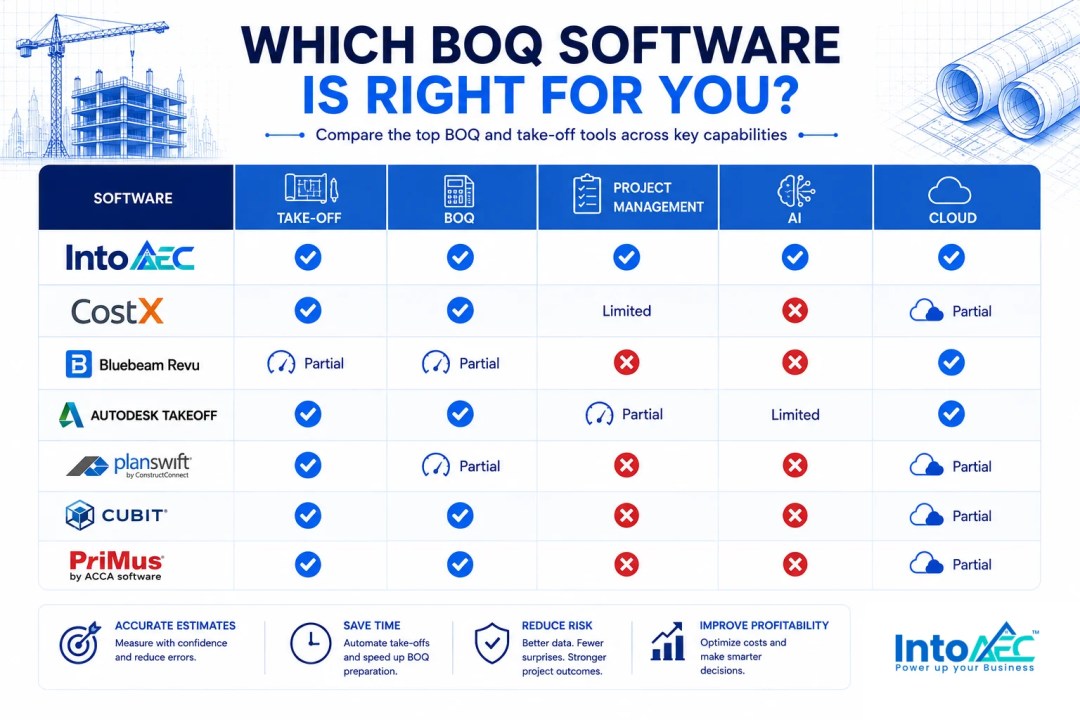
How should UAE contractors choose the right BOQ software?
Every construction company has different priorities.
Rather than asking, “Which software is the most popular?”, firms should ask, “Which software fits our workflow?”
Before making a decision, consider the following questions:
How many estimates do you prepare each month?
Companies producing hundreds of estimates every year benefit from software that automates repetitive work and standardises templates.
Does your team still work with spreadsheets?
If estimators frequently export quantities into Excel before preparing the final BOQ, there is likely an opportunity to streamline the workflow.
Will the software grow with your business?
Construction firms often start with estimating software but later require procurement, scheduling, RFIs, document management and progress tracking.
Choosing software that already supports these capabilities reduces future implementation costs.
Does it support collaboration?
Estimating is no longer performed by one individual.
Modern BOQs often involve collaboration between quantity surveyors, project managers, procurement teams and directors.
Cloud-based software enables everyone to work from the latest information without version conflicts.
Does it integrate with the rest of the project?
One of the biggest inefficiencies in construction occurs when the BOQ exists separately from procurement, scheduling and project delivery.
Integrated platforms reduce duplicate data entry and ensure information flows throughout the entire project lifecycle.
Why integrated construction platforms are replacing standalone estimating tools
Traditional estimating software focuses on one stage of the construction lifecycle: producing accurate Bills of Quantities.
While this remains essential, today’s contractors require much more than estimating.
Projects involve:
- Document management
- RFIs
- Procurement
- Scheduling
- Progress tracking
- Budget management
- Inventory
- Daily site reporting
- Client communication
When each function uses different software, teams spend considerable time transferring information between systems.
Integrated construction platforms eliminate these silos.
A BOQ created during tender can become the foundation for procurement, budgeting and project execution without re-entering data.
This not only improves efficiency but also reduces the likelihood of costly errors caused by duplicated information.
How IntoAEC helps UAE construction firms
IntoAEC was built specifically for architecture, engineering and construction professionals who want to manage projects from tender through completion within a single connected platform.
Instead of treating BOQ preparation as an isolated activity, IntoAEC links estimating with every major stage of project delivery.
Using IntoAEC, teams can:
- Perform AI-assisted 2D quantity take-offs
- Generate structured Bills of Quantities
- Manage drawing revisions
- Track procurement
- Create purchase orders
- Monitor budgets
- Manage RFIs
- Coordinate project schedules
- Store construction documents
- Track site progress
- Collaborate across multiple teams
Zyra AI assists by automating repetitive processes such as quantity extraction, document organisation and structured data preparation, allowing quantity surveyors to focus on commercial decisions rather than manual administration.
You do not interact directly with the AI.
You simply complete accurate BOQs in less time while maintaining complete visibility across the entire project lifecycle.
Conclusion
Selecting the best BOQ software is no longer simply a technology decision. It is a commercial decision that directly influences estimating accuracy, tender turnaround times, procurement efficiency and ultimately project profitability.
For UAE construction firms, the pressure to deliver competitive bids while maintaining cost certainty continues to increase. Clients expect transparent pricing, consultants require comprehensive documentation and projects often operate under FIDIC contracts where every quantity matters. Relying on disconnected spreadsheets or multiple standalone applications creates unnecessary risk through duplicated work, inconsistent information and manual errors.
The seven software solutions featured in this guide each bring valuable capabilities to the estimating process. Some excel at digital take-offs, others provide advanced quantity surveying tools or BIM integration. The right choice depends on your firm’s size, project complexity and long-term digital strategy.
However, firms looking beyond estimating alone should consider how the BOQ fits into the wider construction lifecycle.
A Bill of Quantities should not exist in isolation.
It should connect seamlessly with procurement, project scheduling, RFIs, budgeting, document management and project execution. When all these workflows operate within one platform, information flows naturally from tender through project completion, eliminating duplicate data entry and improving collaboration across every department.
IntoAEC has been designed with this connected workflow in mind. Rather than providing only estimating functionality, it enables construction professionals to manage the complete project lifecycle while maintaining a single source of truth for drawings, quantities, procurement and project delivery.
Want to see how modern BOQ software can transform your estimating process?
Discover how IntoAEC helps UAE construction firms produce accurate Bills of Quantities faster while connecting estimating directly with procurement, scheduling, documentation and project management.

Frequently Asked Questions
The best BOQ software depends on your business requirements. Companies should evaluate digital take-off capabilities, BOQ generation, collaboration features, revision management, cloud accessibility and integration with project management systems. Firms seeking an end-to-end construction platform should also consider how the software supports procurement, scheduling and document management.
Spreadsheets increase the risk of manual errors, inconsistent formulas, duplicate data entry and version control problems. Modern BOQ software automates calculations, standardises templates, links quantities directly with drawings and provides better collaboration across project teams.
Cloud-based solutions allow multiple users to collaborate in real time, access current project information from any location and maintain consistent document versions. This is particularly beneficial for construction projects involving distributed teams, consultants and subcontractors.
Many modern platforms integrate BOQ preparation with procurement, budgeting, scheduling, RFIs and document management. This removes the need to transfer information manually between different systems and creates a connected project workflow.
Before investing, firms should consider:
Project size
Number of estimates prepared annually
Team collaboration requirements
BIM compatibility
Procurement workflows
Integration with existing software
Scalability for future business growth
Choosing software that supports the entire construction lifecycle often delivers greater long-term value than selecting an estimating-only solution.