

Table of contents
- What is the meaning of a bill of quantities?
- What are the 8 components of a winning BOQ?
- Why does the order of these 8 components matter?
- What is the most commonly missing component?
- How does BOQ software keep all 8 components consistent?
- Conclusion
Every winning tender starts with the same eight sections in the same order, even when the project is entirely different. A bill of quantities meaning is easy to state in one line, but the eight components that make a bill actually work are where most tenders quietly fall apart. This guide walks through each one, in order, with a short example, so you can build or check a bill that holds up from tender to final account.
What is the meaning of a bill of quantities?
Bill of quantities meaning, in plain terms, is a measured shopping list for a construction project, organised so every bidder prices exactly the same scope. It translates drawings and specifications into priced, comparable lines. Each line states a quantity and unit, and leaves a column for the contractor’s rate. Multiply quantity by rate across every item, and the total becomes the tender price. Because the scope is fixed, the client can compare bids like-for-like instead of guessing what each contractor assumed.
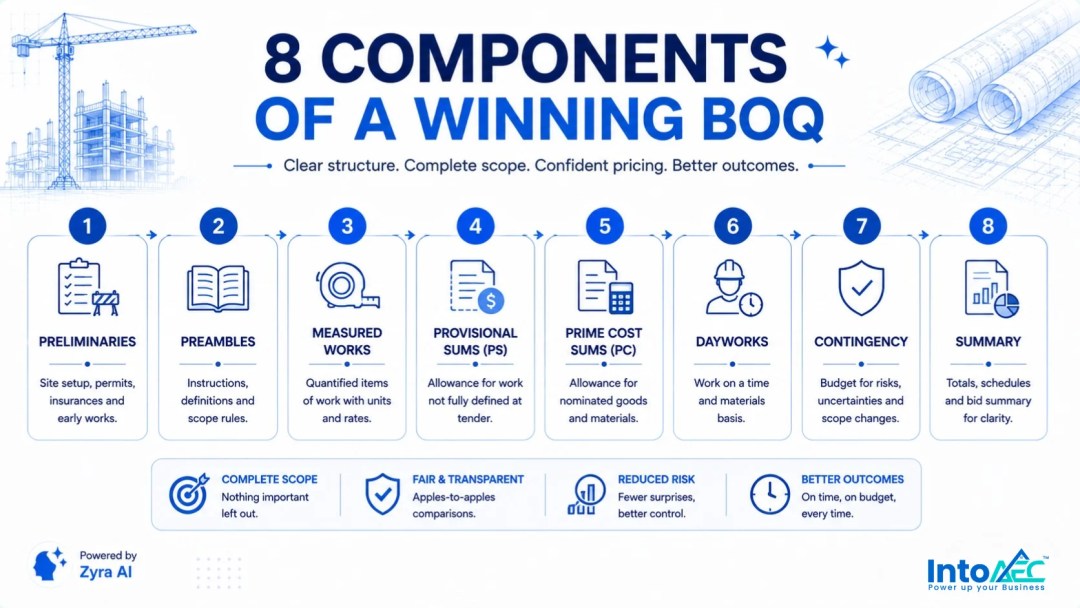
What are the 8 components of a winning BOQ?
1. Preliminaries. The project-wide costs incurred before and alongside the main works, such as site set-up, supervision, temporary works and insurances. Example: a lump sum for site management and welfare facilities for the duration of the project.
2. Preambles. The notes that define how each item is measured and what a rate is deemed to include, so every bidder interprets the bill the same way. Example: a preamble stating that all painting rates include two coats unless stated otherwise.
3. Measured works. The priced items of permanent work, grouped by trade or building element, forming the bulk of the bill. Example: 200 cubic metres of reinforced concrete, priced per cubic metre.
4. Provisional sums. Allowances for work that is foreseen but not yet fully designed at tender stage. Example: a provisional sum for external landscaping pending final design approval.
5. Prime cost (PC) sums. Allowances for materials or specialist work supplied by a nominated supplier, kept separate from the contractor’s own priced work. Example: a PC sum for a client-selected sanitaryware supplier.
6. Dayworks schedule. Pre-agreed rates for labour, plant and materials used on a time-and-materials basis, for work that genuinely cannot be measured in advance. Example: hourly rates agreed for unforeseen structural remedial work.
7. Contingency sum. A stated allowance held against unforeseen conditions and risks, kept visible and separate from the priced scope. Example: a contingency line covering unknown ground conditions on a refurbishment.
8. Summary. The final section where every component total rolls up into the overall tender figure, giving a one-page view of the whole bill. Example: a summary page totalling preliminaries, measured works, provisional sums, PC sums, dayworks and contingency into the final price.
Related reading: BOQ full form and definition and 7 types of BOQ every estimator should know.

Why does the order of these 8 components matter?
The order is not arbitrary, it mirrors how cost risk is allocated across a project. Preliminaries and preambles come first because they set the ground rules the rest of the bill depends on. Measured works form the priced core. Provisional and PC sums flag what is still uncertain. Dayworks and contingency give a home for the unplannable. The summary closes the loop by making every total auditable at a glance. Skip a step, and the components after it lose the context that makes them meaningful.
What is the most commonly missing component?
The contingency sum and the summary are the two components most often missing or under-detailed on bills that later run into disputes. Without a contingency line, unforeseen costs have nowhere agreed to sit, so they become variation claims. Without a clear summary, checking whether the bill adds up correctly means manually totalling hundreds of lines, which is exactly where reconciliation errors creep in at final account stage.
How does BOQ software keep all 8 components consistent?
BOQ software keeps all 8 components consistent by enforcing the structure every time, instead of relying on whoever built the spreadsheet to remember every section. With IntoAEC, your 2D Take off feeds straight into a structured BOQ template that already carries all 8 components, so nothing gets left out by habit or oversight. Zyra AI handles the repetitive measuring and formatting, while your quantity surveyors keep control of the rates and the judgement calls that actually need a human. You do not interact with the AI. You just stop doing the work it handles.
Conclusion
Bill of quantities meaning is simple to state, but a winning bill depends on getting all 8 components right, in order, every time. Miss the contingency sum or the summary, and the gaps show up exactly when you can least afford them, at final account. Want every component built in automatically?
See how IntoAEC structures a complete BOQ from your drawings in minutes.

Frequently asked questions
A bill of quantities is a structured, itemised document listing every item of work, material and quantity needed for a project, so every bidder prices the same defined scope.
Preliminaries, preambles, measured works, provisional sums, PC sums, a dayworks schedule, a contingency sum and a summary, in that order.
Each component sets up context for the ones that follow, from the ground rules in the preliminaries and preambles through to the auditable totals in the summary.
Unforeseen costs have no agreed place to sit, so they tend to surface later as variation claims rather than being absorbed as planned.
Yes. Structured BOQ software applies a consistent template with all 8 components built in, so sections cannot be silently skipped the way they can be in a blank spreadsheet.
Related articles
- What Is BOQ in Construction? Meaning, Types, Components & Uses (2026)
- BOQ Full Form in Construction: What Does BOQ Stand For?
- 7 Types of BOQ Every Estimator Should Know (with Examples)
- BOQ in Construction: 10 Things Every UAE Contractor Must Include in a Bill of Quantities
- Why Contractors Lose Money for Poor Project Coordination (and How to Fix It)