

Table of contents
- Table of contents
- What are preliminaries in construction?
- Why are preliminaries so easy to under-price?
- Site supervision and management
- Should preliminaries be calculated as a percentage?
- How can quantity surveyors improve preliminary cost control?
- How does BOQ software help manage preliminaries?
- Conclusion
- Frequently asked questions
- Related articles
A construction estimate can look accurate on paper and still lose money before the first major trade package begins.
The problem is often not concrete, steel, finishes or mechanical services. It is the collection of project-wide costs sitting underneath them: site establishment, supervision, temporary facilities, security, access, testing, permits, utilities and other costs required to keep the project running.
These are preliminaries in construction.
Because preliminaries do not always translate into a visible permanent asset, they are easy to underestimate during tender preparation. A contractor may focus heavily on measured works while treating site overheads as a percentage or a single lump sum.
That approach can create a significant gap between the tender allowance and the actual cost of delivering the project.
For UAE contractors, the challenge can be even greater on projects where site conditions, working hours, logistics, authority requirements and project duration significantly affect the cost of maintaining the site.
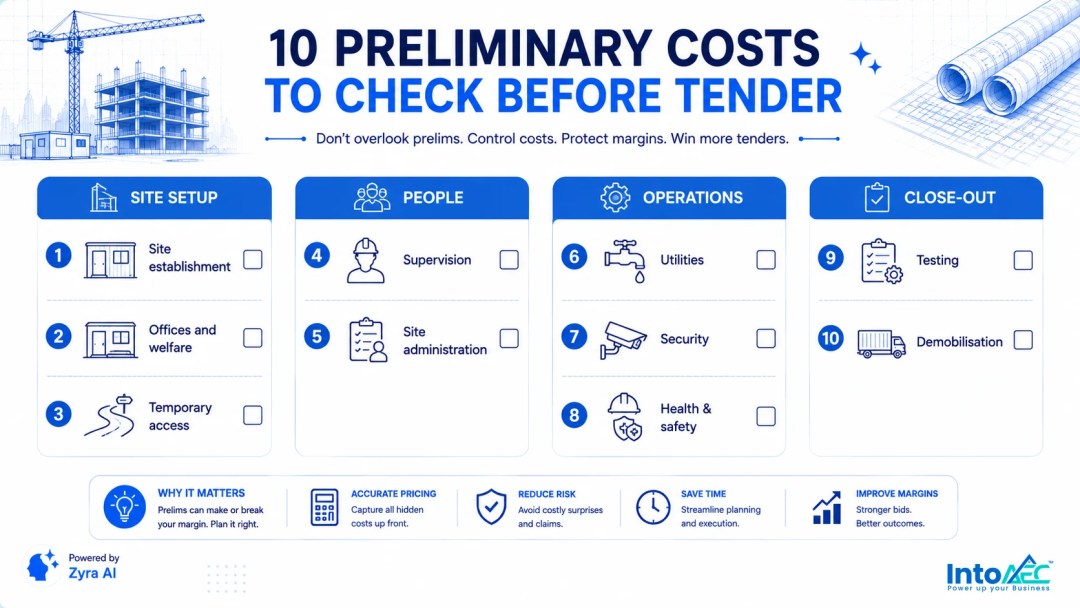
This guide explains the preliminary items quantity surveyors should examine carefully before finalising a tender, with practical examples of where under-pricing can occur and how better cost control can prevent those costs from becoming project surprises.
What are preliminaries in construction?
Preliminaries are the costs associated with running and supporting a construction project rather than producing a specific permanent element of the finished building.
For example, the cost of installing 500 square metres of floor tiles can be measured directly and included under measured works.
But someone needs to provide:
- a site office,
- temporary electricity,
- site security,
- supervision,
- welfare facilities,
- safety arrangements,
- temporary access,
- project administration and
- site management.
Those costs support the entire project rather than one particular trade.
They therefore sit within the preliminary section of the BOQ or estimate.
The exact items included will vary according to the project, contract and procurement requirements. The important point for quantity surveyors is that preliminaries should be assessed against the actual resources required to deliver the project rather than treated as an automatic percentage of the construction value.
Why are preliminaries so easy to under-price?
There is a fundamental difference between measuring a permanent work item and estimating the cost of running a construction site.
A quantity surveyor can measure the area of a floor, the volume of concrete or the length of pipework relatively directly.
Preliminary costs are different.
They depend on factors such as:
- Project duration
- Site location
- Site access
- Number of workers
- Working hours
- Site restrictions
- Security requirements
- Temporary facilities
- Authority requirements
- Contractor’s management structure
- Construction methodology
A project that takes 12 months to complete will generally require project resources for much longer than one lasting six months.
If those resources are priced as a percentage without checking the programme, the preliminary allowance may be too low before construction even starts.
1. Site establishment
Site establishment is one of the first areas where preliminary costs can be underestimated.
Before construction begins, the contractor may need to establish the physical infrastructure required to operate the site.
This can include:
- Hoarding
- Site offices
- Welfare facilities
- Storage areas
- Temporary fencing
- Signage
- Access arrangements
- Temporary lighting
- Site cabins
- Material storage
The cost is not limited to purchasing or installing these facilities.
The estimate may also need to account for their maintenance, relocation and eventual removal depending on the project requirements.
Example
A contractor prices a project assuming that existing site access will remain available throughout construction.
Later, access restrictions require additional temporary arrangements for deliveries and worker movement.
The original preliminary allowance did not account for this requirement.
The project now has an unplanned cost that could have been identified during tender review.
The lesson is simple: site establishment should be based on the actual construction environment, not a generic allowance.
2. Site offices and welfare facilities
Construction workers require appropriate welfare and administrative facilities throughout the project.
Depending on the project, these may include:
- Offices
- Meeting rooms
- Toilets
- Wash facilities
- Changing areas
- Break areas
- Storage
- Temporary accommodation
Quantity surveyors should consider both the initial setup and ongoing costs.
A longer project means facilities may need to remain operational for a longer period.
A larger workforce may also require additional capacity.
This is particularly important when the programme changes.
If the project is extended by several months, the cost of keeping temporary facilities operational can continue accumulating even though the original allowance has already been spent.
3. Site supervision and management
Site management is one of the most significant preliminary cost categories and one that can be underestimated when project staffing is not aligned with the programme.
Depending on project size and complexity, the site team may include:
- Project managers
- Site managers
- Engineers
- Quantity surveyors
- Document controllers
- Safety personnel
- Supervisors
- Administrative staff
The cost of these resources is directly influenced by project duration.
A common estimating mistake is to focus on the initial programme without considering whether the proposed management structure remains adequate if the project becomes more complex.
For example, a project initially planned for 12 months may require additional supervision during overlapping fit-out, MEP and finishing activities.
If the preliminary allowance only covers the original staffing assumption, the contractor can absorb additional management costs without a corresponding increase in the original estimate.
4. Temporary utilities
Construction sites require utilities before the permanent building services are operational.
These can include:
- Electricity
- Water
- Temporary lighting
- Telecommunications
- Data connectivity
- Wastewater arrangements
The cost can vary significantly depending on the location, site conditions and project duration.
Temporary electricity is particularly easy to overlook because the final building will eventually have its own permanent electrical system.
But the construction team still needs power during the period when that permanent system is unavailable.
The estimate should therefore consider how temporary utilities will be supplied, maintained and eventually disconnected.
5. Security
Security requirements can vary considerably between projects.
A project in a controlled development may have different requirements from a standalone construction site.
Potential preliminary costs include:
- Security personnel
- Access control
- CCTV
- Temporary lighting
- Security equipment
- Gate management
Security should be considered alongside the programme and site operating conditions.
A longer construction period means security resources may need to remain in place for longer.
If security is treated as a small generic allowance rather than a project-specific requirement, the final cost can quickly exceed the original estimate.
6. Temporary access and protection
Construction sites rarely operate under ideal conditions.
Temporary roads, walkways, barriers, protection systems and access arrangements may be required to allow different trades to work safely and efficiently.
These requirements can change as construction progresses.
For example, an access route used during structural works may need to be relocated during façade installation or fit-out.
The cost is therefore not necessarily a one-time expense.
Quantity surveyors should consider the construction sequence and identify where temporary works or access arrangements will need to change during the programme.
7. Health and safety requirements
Health and safety is another area where preliminary costs should reflect actual project requirements.
Depending on the project, costs can include:
- Safety personnel
- Signage
- Protective barriers
- Site induction arrangements
- Safety equipment
- Temporary protection
- Training and documentation
The important point is not simply to include a safety allowance.
The estimate should identify what the project actually requires and for how long.
A detailed construction programme can help quantity surveyors identify when specific safety resources or temporary arrangements will be required.
8. Testing, inspections and documentation
Testing and inspection requirements can also become overlooked preliminary costs.
Construction projects may require coordination of inspections, testing procedures, documentation and approvals throughout the works.
The associated costs can include:
- Testing arrangements
- Specialist inspections
- Documentation
- Sample approvals
- Compliance records
- Quality control administration
The exact requirements depend on the project specifications and contract.
The key estimating principle is to review these obligations before tender rather than discovering them after construction begins.
9. Project administration and document control
Modern construction projects generate significant amounts of documentation.
Drawings, revisions, RFIs, approvals, inspection records, reports, correspondence and other project documents need to be managed throughout the project.
This creates a real resource requirement.
Depending on project size, the contractor may need dedicated administrative or document-control resources.
If those resources are omitted from the preliminary estimate, the contractor may eventually have to absorb the cost internally.
10. Demobilisation and site clearance
Preliminaries do not end when the last major trade finishes.
At project completion, the contractor may need to remove:
- Site offices
- Temporary facilities
- Hoarding
- Storage arrangements
- Temporary utilities
- Construction waste
- Temporary protection
The site must then be cleared and handed over according to the project requirements.
Demobilisation is often overlooked because estimating naturally focuses on the start and middle of construction.
But closing the site is also part of delivering the project.
Should preliminaries be calculated as a percentage?
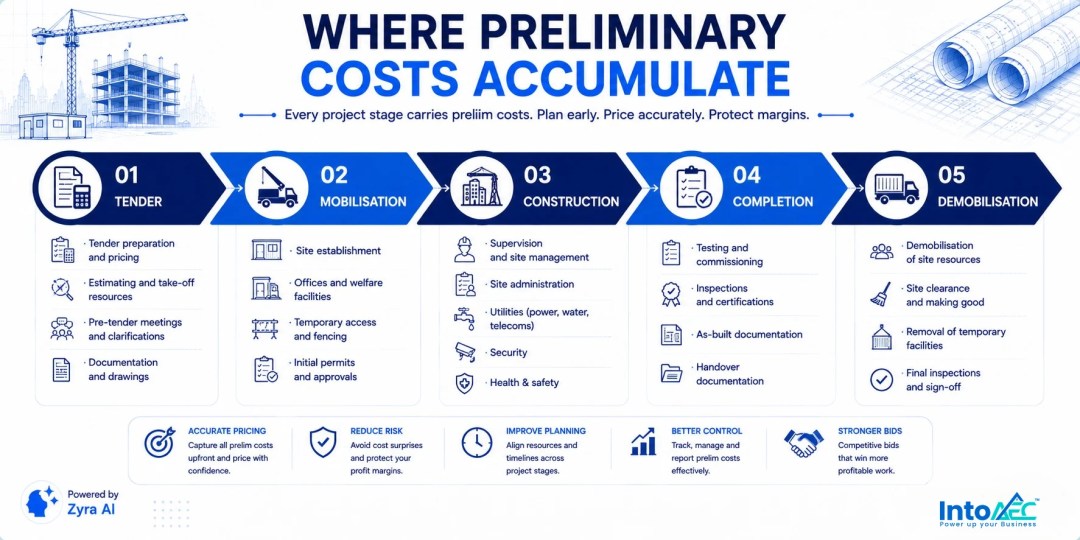
Using a percentage can provide a useful high-level estimating approach, but it should not replace a detailed review of actual preliminary requirements.
A percentage-based allowance can hide the factors that actually drive the cost.
For example, two projects may have similar contract values but completely different:
- durations,
- site constraints,
- staffing requirements,
- access conditions,
- security needs and
- temporary facilities.
Their preliminary costs therefore may not be proportionate to their overall contract values.
A better approach is to build the preliminary estimate from the resources and requirements of the specific project.
The quantity surveyor can then use the percentage as a cross-check rather than the primary method of calculation.
How can quantity surveyors improve preliminary cost control?
The most effective way to improve preliminary cost control is to connect the estimate to the construction programme and methodology.
Before finalising the tender, review:
1. Project duration
How long will site facilities, management staff, security and temporary services be required?
2. Construction methodology
What temporary facilities or access arrangements are required to execute the works?
3. Site constraints
Are there restrictions on deliveries, working hours, storage or access?
4. Workforce requirements
How many workers and supervisors will the project require during each stage?
5. Contract requirements
What project administration, reporting, testing and compliance obligations must be fulfilled?
6. Close-out requirements
What resources will be required to demobilise and hand over the site?
This approach turns preliminaries from a generic percentage into a project-specific cost model.
How does BOQ software help manage preliminaries?
A structured BOQ makes it easier to separate preliminary costs from measured works and review each cost category before tender submission.
Instead of placing all project overheads into a single percentage, quantity surveyors can build a detailed preliminary section with individual items, units, quantities and rates.
With IntoAEC, the BOQ workflow provides a structured environment for organising project costs alongside the quantities generated through the 2D Takeoff workflow.
This gives estimators a clearer connection between drawings, measured quantities and the wider cost structure.
Zyra AI can assist with repetitive estimating and document-related work, while quantity surveyors retain control over the assumptions, rates and commercial decisions that require professional judgement.
The objective is not to replace the quantity surveyor.
It is to reduce the repetitive work that makes it easier for important cost items to be missed.
Conclusion
Preliminaries in construction are rarely the most visible part of a tender, but they can have a major impact on whether the project remains commercially viable.
Site establishment, supervision, temporary utilities, security, access, safety, documentation and demobilisation all require resources. When these requirements are underestimated, the contractor can end up carrying costs that were never properly allowed for in the original tender.
The solution is not simply to increase the preliminary percentage.
It is to understand what the project actually requires.
Quantity surveyors should review preliminaries against the construction programme, site conditions, methodology, workforce requirements and contractual obligations before finalising the tender.
A structured BOQ also makes this process easier by giving every preliminary requirement a defined place rather than hiding project-wide costs inside a single allowance.
With IntoAEC, quantity surveyors can connect structured BOQs with digital take-offs and the wider project workflow, creating better visibility from estimating through project delivery.
Want better control over your construction estimates?
See how IntoAEC helps quantity surveyors build structured BOQs, perform digital take-offs and manage project costs from one connected platform.

Frequently asked questions
Preliminaries are project-wide costs required to organise, manage and operate a construction project. They can include site establishment, supervision, temporary facilities, utilities, security, safety, administration, testing and demobilisation.
Preliminaries cover the resources required to run the project. Under-pricing them can leave contractors with additional costs that are difficult to recover, particularly when project duration or site requirements change.
Common items include site offices, welfare facilities, supervision, temporary utilities, security, access arrangements, health and safety, project administration, testing, documentation and demobilisation.
A percentage can be useful as a high-level benchmark or cross-check, but preliminary costs should ideally be assessed against the actual project duration, site conditions, methodology, staffing requirements and contractual obligations.
Structured BOQ software allows quantity surveyors to organise preliminary items individually rather than relying on a single generic allowance. This improves visibility, makes estimates easier to review and helps connect preliminary costs with the wider project estimating workflow.