

Table of contents
Most variation disputes in Australian construction don’t start on site. They start months earlier, in a scope of work section someone wrote quickly, copied from the last job, and never tested against the drawings and specifications. By the time the gap shows up, it’s not a wording problem anymore. It’s a payment claim, a delayed program, and a conversation nobody wanted to have.
A scope of work document doesn’t need to be long to do its job. It needs to cover the nine things that actually get argued about later. Here they are, in the order most contracts miss them.
1. Description of the Works
A plain-language summary of what’s being built, before any technical detail. This sounds obvious, but contractors most often leave this clause vague: “supply and install associated works.” Everyone drafting the contract knows what they mean. The problem is the description has to hold up months later, for someone who wasn’t in the room, possibly in front of an adjudicator.
2. Inclusions and Exclusions
An explicit list of what’s covered and, just as importantly, what isn’t. Exclusions save the most arguments, because courts and adjudicators almost always read silence on an item in the client’s favour. If temporary fencing, make-good works, or a specific trade package sits outside scope, the document needs to say so in writing rather than leave it assumed as “obviously not included.”
3. Specifications and Standards
The technical standard the finished work has to meet. In Australia this usually means a project-specific specification read alongside the National Construction Code, naming any relevant Australian Standards explicitly rather than assuming them. Vague specification wording, “to a good standard,” “as required,” is where quality disputes and defect arguments almost always begin.
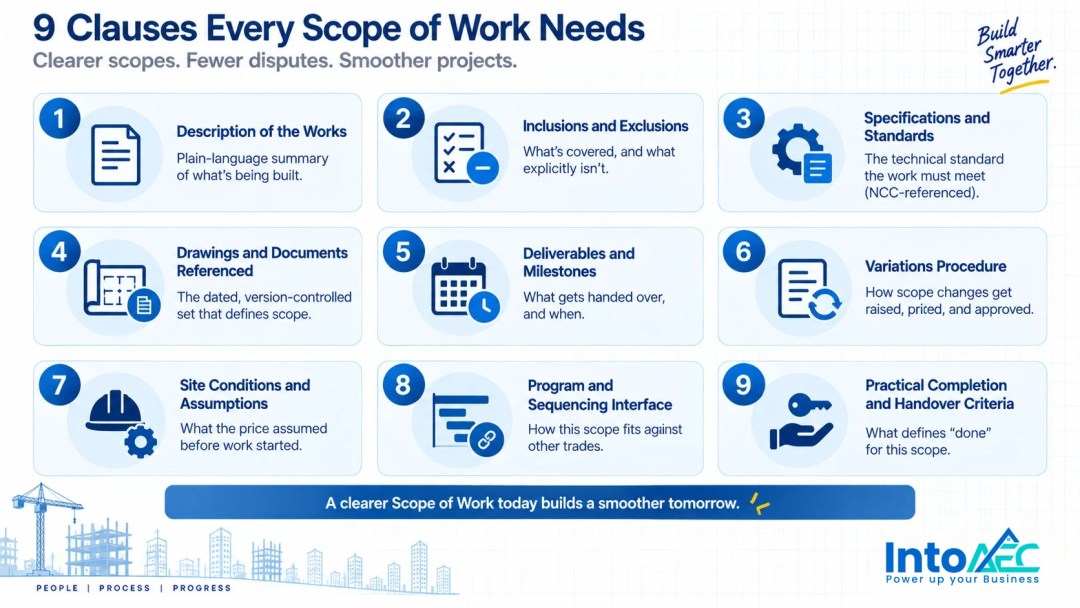
4. Drawings and Documents Referenced
A dated, version-controlled list of exactly which drawings, schedules, and BOQ items define the scope. Without this, “the scope” quietly becomes whichever drawing revision someone happens to be looking at that week. A scope clause that says “per drawings issued for construction” without naming a revision number is really saying “per whichever version we argue about later.”
5. Deliverables and Milestones
What the contractor hands over, and at what point in the program. This clause connects the scope to the schedule. It’s the difference between “install the HVAC system” and “install and commission the HVAC system by the date the builder needs it for services testing.” Without a milestone tied to it, a deliverable has no enforceable deadline.
6. Variations Procedure
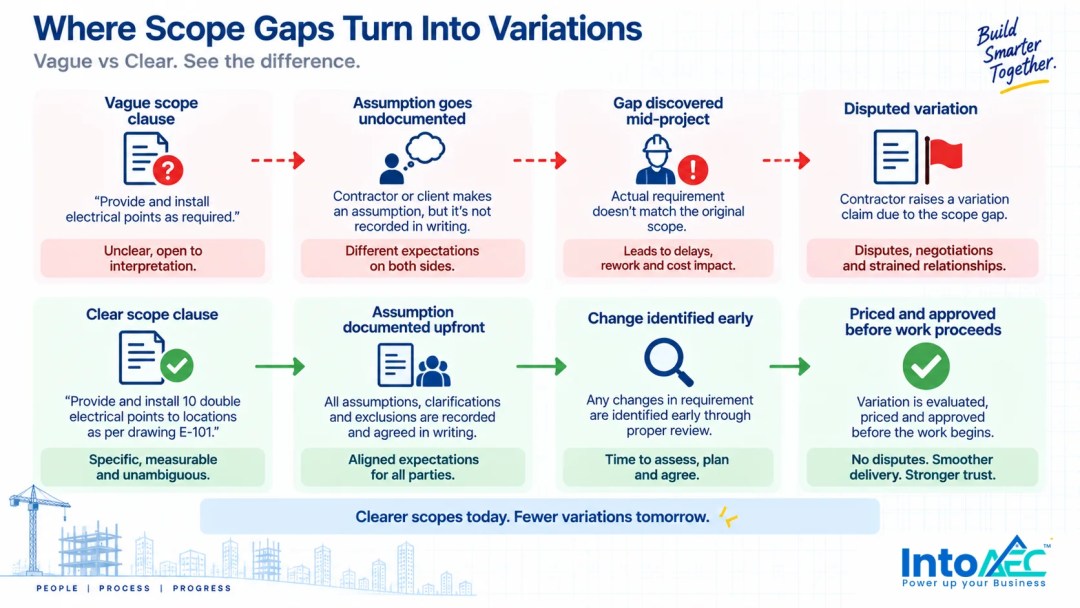
How the team raises, prices, and approves a change to scope, before the work happens, not after. Most standard Australian contract forms build in a formal variation-direction process for exactly this reason. Work outside the agreed scope needs a documented instruction and an agreed price before it proceeds, not a verbal “just do it and we’ll sort the cost out later.” Without a clear variations procedure, a scope of work is the single biggest reason cost disputes escalate to adjudication instead of getting resolved on site.
7. Site Conditions and Assumptions
What the price assumed about the site before work started. Existing services, access constraints, ground conditions, provisional items, all of these must go into the contract as documented assumptions. “We assumed normal ground conditions” only protects you if the contract actually says so. An assumption nobody documented isn’t a defence later, it’s just a memory.
8. Program and Sequencing Interface
How this scope of work fits against the works of other trades and the overall program. A scope that’s technically complete but silent on sequencing (who mobilises first, who needs clear access when) creates exactly this kind of coordination dispute. Three trades later, it shows up as a delay claim.
9. Practical Completion and Handover Criteria
The specific conditions that define “done” for this scope, not just “finished to a good standard.” This should tie back to the specifications clause: what testing, commissioning, or documentation must accompany handover before the parties consider this scope complete and the client releases the retention or final payment.
Where the Variations Procedure Actually Breaks Down?
Clause 6 is worth a closer look, because it’s rarely the written procedure that fails. Most Australian construction contracts already have a variations clause. The failure is almost always in how consistently teams follow it on site. Someone asks a supervisor to do “one more thing” verbally. The supervisor agrees because refusing feels unhelpful, and nobody creates the paper trail that should have protected both parties. Three months later, that verbal instruction is a disputed claim with no documentation on either side.
How IntoAEC’s Change Order Feature Closes That Gap?
IntoAEC’s Change Order feature handles exactly this moment. When the team identifies a scope gap, whether it’s a site condition that didn’t match the assumptions clause, a specification change, or genuinely new work outside the original description, Change Order captures it as a formal record: what changed, why, and against which part of the original scope. It applies that change directly to the estimate, calculating the cost impact against actual numbers rather than guessing after the fact. Then it routes the variation for the client’s sign-off with a signature before the work proceeds.
That sequence, capture the change, price it against the estimate, get sign-off before proceeding, is precisely the procedure clause 6 calls for. The difference is that it all happens inside the same system holding the original scope, drawings, and BOQ. No separate spreadsheet or email thread to lose track of. A verbal “just do it” instruction becomes much harder to justify when logging the change takes less time than the conversation did.
None of this replaces having a well-drafted scope of work in the first place. When reality doesn’t match the document, as it eventually does on every project, there’s a clean, timestamped record of what changed and who agreed to it.
Want to see how a scope gap turns into a signed-off variation inside IntoAEC? Read how manual take-offs and scope gaps quietly cost projects money, or book a free demo and walk through the Change Order workflow against one of your own contracts.

Frequently Asked Questions
At minimum, a clear description of the works, explicit inclusions and exclusions, referenced specifications and standards, the drawings and documents that define it, deliverables tied to milestones, a variations procedure, documented site assumptions, its interface with the program, and clear completion criteria.
Most disputes trace back to gaps in the written document: a description the parties left vague, an exclusion nobody stated explicitly, a site condition the contractor never documented, or a variation the team agreed verbally instead of through the contract’s formal procedure.
An inclusion states what’s definitely covered. An exclusion states what’s definitely not covered. Assumptions state a condition the price was based on, like normal ground conditions, that isn’t guaranteed and may trigger a variation if it turns out to be wrong.
Because scope changes on almost every project regardless of how well it was defined at the start. The variations procedure is what turns an inevitable change into a priced, approved instruction instead of an undocumented dispute.
No. IntoAEC doesn’t draft contract language. What it does is capture scope changes once the team identifies them, apply them to the estimate, and route them for sign-off through Change Order, so a variation has a clean record from the moment someone raises it.


