

Table of contents
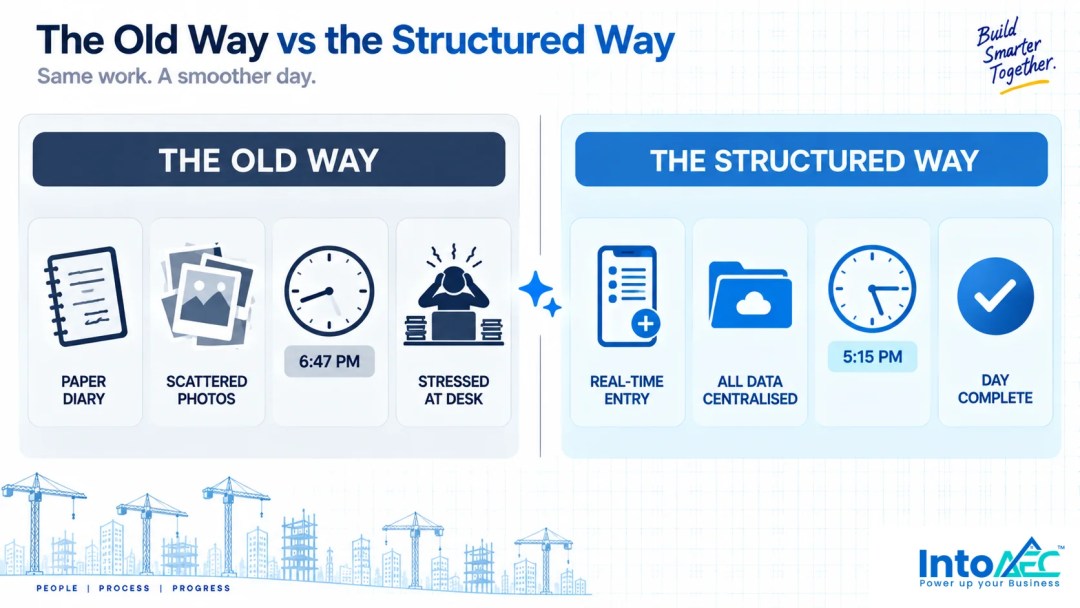
It’s 6:47pm. The last bakkie has pulled off site. The security guard’s doing his rounds. And you’re still at the site office typing up today’s daily report — labour counts, plant hours, weather delays, the snag that came up on the third floor, photos you need to find and attach, and the three WhatsApp messages from your QS asking where yesterday’s report went. By the time it’s done and emailed off, it’s gone eight. Tomorrow, you do it again. If this is your evening more nights than not, you’re not managing the site badly — you’re managing it with a system that can’t keep up with how fast a real site actually moves.
The Daily Report Isn’t the Problem. How You’re Doing It Is!
Every site manager in South Africa knows the daily report isn’t optional. It’s your record for the QS, your evidence if a dispute lands on the PM’s desk six months later, and often the only proof that a delay wasn’t your fault. The trouble isn’t that the report exists — it’s that most site teams still build it the same way they did fifteen years ago. They keep a paper diary or a loose spreadsheet during the day. Then at knock-off, they scramble to turn scrawled notes and a phone full of photos into something coherent enough to send.
That gap between “what happened on site” and “what’s written down” is where the evening hours disappear. That’s also where information quietly slips away. A labour headcount slightly off. A delay reason nobody wrote down properly. A photo that never made it into the file.
What’s Actually Eating Your Time Every Evening
Talk to enough site managers and site agents across Gauteng, KwaZulu-Natal, and the Western Cape, and the same list comes up:
- Rebuilding the day from memory. If you didn’t note something the moment it happened, you’re reconstructing it at 6pm from a mental timeline that’s already fading.
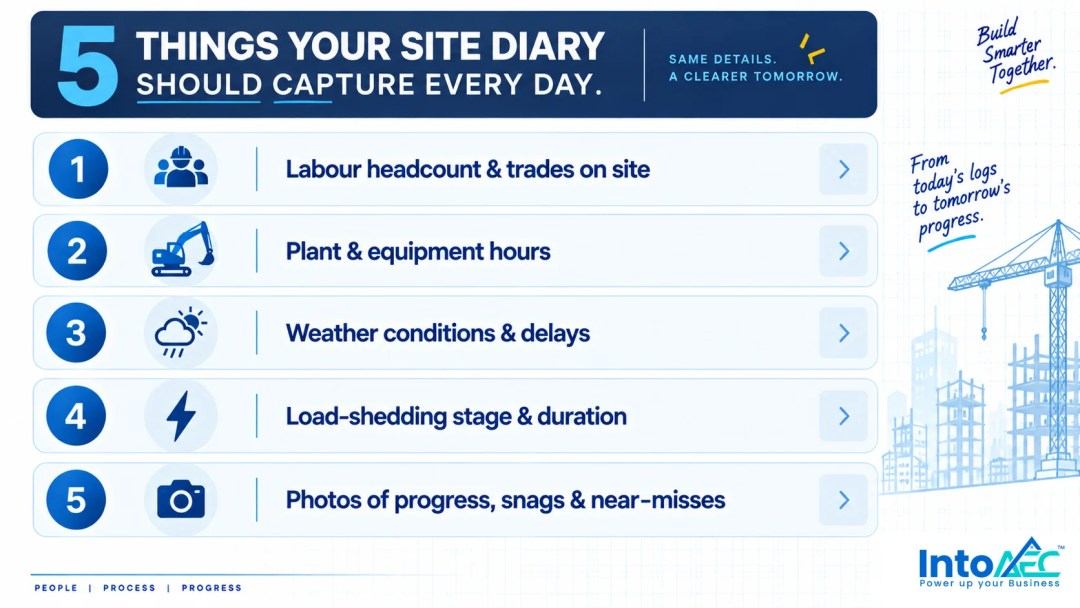
- Load-shedding disruption tracking. Stage 2 this morning, stage 4 by 2pm — every outage affects plant runtime, concrete pours, and labour productivity, and you need to log every one accurately for claims and programme adjustments. Doing this from memory at the end of the day is how hours quietly go unaccounted for.
- Chasing photos across three different phones. The foreman took photos of the snag. The safety officer photographed the near-miss. None of it is in one place when you sit down to write the report.
- Re-keying the same data into different formats — a paper diary entry you type into a spreadsheet and then copy into an email.
- Weather and delay documentation that needs to hold up if a claim or dispute comes later, but you write it in a rush with none of the detail that would actually support it.
None of this is a “site management” failure. It’s a paperwork-design failure. You run the site well — documenting it is what’s broken.
Why This Matters More Than Just Your Evening
A daily report that’s rushed, incomplete, or reconstructed from memory isn’t just an inconvenience — it’s a risk. If a delay claim goes to arbitration, vague or inconsistent diary entries weaken your position. If an incident happens on site and the daily log doesn’t capture it properly, that’s a gap in your OHS Act record-keeping. It can come back to bite the company, not just you. Under the OHS Act, incident and site condition documentation isn’t a nice-to-have. It’s part of the legal record that contractors must maintain. Daily site logs are often the first thing auditors check when a dispute arises.
Why Proper Documentation Protects You
Good documentation, done consistently, protects the site manager as much as it protects the client.
What “Fixing” the Daily Report Actually Looks Like
This isn’t about working faster at the same broken process. It’s about restructuring how you capture information in the first place. The tools worth looking at share a few things in common:
- Capture happens in real time, not at the end of the day. You log photos, labour counts, and delay notes as they happen — from a phone, on site — not hours later from memory.
- One place for everything. Photos, weather, plant hours, labour, and notes live in a single structured log. They’re no longer split across a diary, a phone gallery, and a spreadsheet.
- The report writes itself from what’s already logged, instead of you retyping the day’s events into a document from scratch.
- It’s still your report, your record, your evidence — just built from structured data captured through the day rather than assembled under pressure at 6pm.
That’s the shift IntoAEC’s Daily Report / Daily Log module IntoAEC built around — a standing, structured module that lets site teams log labour, plant, weather, delays, and site photos as the day happens, so the report is largely compiled by the time you sit down to review it, rather than written from scratch.
It’s worth being clear about what this is and isn’t: this is a structured, well-designed logging workflow — not an AI system writing your report for you. IntoAEC’s Zyra AI is genuinely useful elsewhere in the platform today — for example, generating a first-pass estimate or a schedule template from a plain-language prompt — and IntoAEC is steadily expanding Zyra AI across more of the platform over time. As that expansion continues, capabilities like smarter daily-report assistance are a natural direction we’re planning toward. For now, the value in the daily reporting workflow itself is the structure: less re-keying, less hunting for photos, less reconstructing the day from memory.
Building a Site Diary Habit That Actually Survives Load-Shedding
Because outages are a fact of site life in South Africa right now, it’s worth building the habit of logging why you lost time, not just that you did. “Stage 4 load-shedding, 10:00–12:30, tower crane and batching plant down” is a defensible entry. “Delayed — power” is not. A structured daily log makes this easy to capture consistently. That matters when your QS pulls up that entry for an EOT claim eight months later.
Conclusion
The daily report was never meant to be the hardest part of your job — running the site was. When the paperwork is fighting you every evening, it’s usually not because you’re disorganised; it’s because the tools weren’t built for how a real South African site actually runs, load-shedding and all. Fixing that isn’t about working later — it’s about capturing the day’s information as it happens, so the report is mostly done by the time you’d normally be starting it from scratch.
If you’re ready to see what a structured daily reporting workflow looks like on a real project, book a free IntoAEC demo and we’ll walk you through it.

Frequently Asked Questions
Construction site management is the day-to-day coordination of labour, plant, materials, safety, and progress on an active construction site — including the documentation (daily reports or site diaries) that records what happened each day for reference, reporting, and dispute resolution.
Because most sites still capture information on paper or scattered notes during the day, then reconstruct the full report from memory at the end of the shift — re-typing data, hunting for photos across different phones, and trying to recall details like exact delay times hours after they happened.
In South Africa, “site diary” and “daily report” are largely used interchangeably — both refer to the daily written record of labour, plant, weather, delays, and progress on site. “Site diary” is the more traditional, commonly used term on South African sites.
Record the load-shedding stage, the exact start and end time of the outage, and which specific plant or activities it disrupted (e.g., tower crane, batching plant, concrete pour). Vague entries like “delayed — power” don’t hold up well if the record is later used to support an extension-of-time claim.
AI can help with parts of the estimating and scheduling process today — for example, IntoAEC’s Zyra AI can generate a first-pass estimate or schedule template from a plain-language prompt. Daily reporting currently benefits most from structured, real-time logging tools rather than full AI automation, though AI-assisted reporting is a natural area platforms plan to expand into over time.


