
Table of contents
It is Tuesday morning, and BCA has just started an audit on your site. The documents the officer needs are spread across a site office folder, three WhatsApp groups and one engineer’s phone. If you manage sites in Singapore, you can picture the scramble. BCA now encourages sites to keep that data in one place. Its Site Management Platform (SMP) programme lets officers check certain documents remotely before they visit. This guide compares eight options for construction management software Singapore contractors can shortlist. It sets BCA’s SMP use cases and AI features side by side. By the end, you can decide which tools deserve a trial.
A note before we start: IntoAEC publishes this blog, and IntoAEC is one of the eight options below. This is our own comparison, not an independent review, and we have not run hands-on benchmarks of every product. We built it from vendor pages, BCA’s published guidance and published reviews, checked on 20 October 2026. The numbering is for readability only and is not a ranking. BCA does not endorse any product named here.
What does BCA’s Site Management Platform programme mean for your software choice?
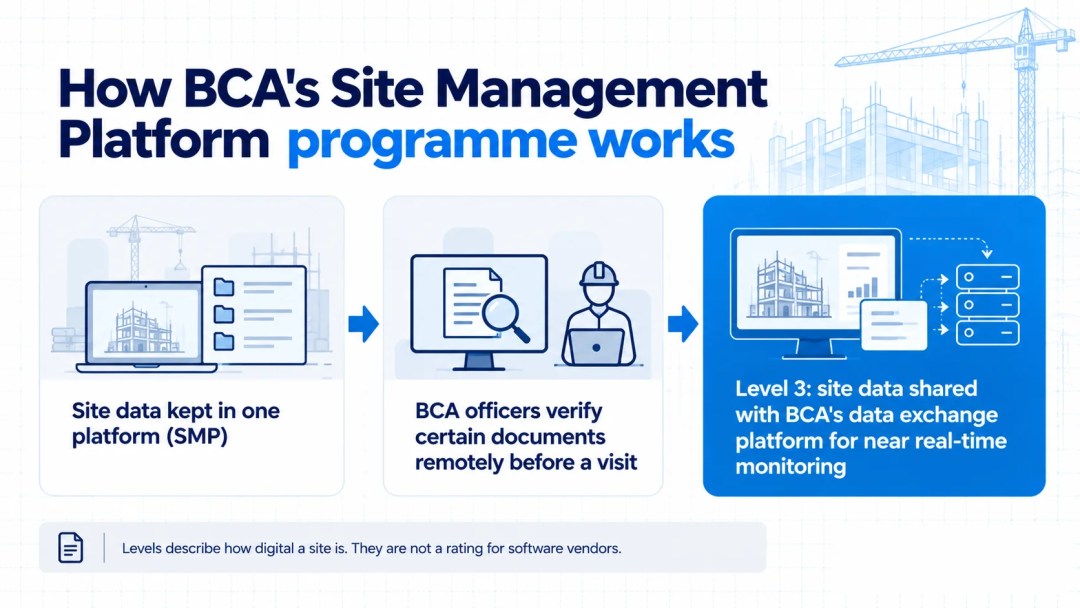
A Site Management Platform is BCA’s term for a centralised digital system that collects, manages and shares site data. BCA uses it to tier its site audits.
BCA describes SMPs as digital tools that collect and organise construction site information in one place. It has published a Guidebook for Site Management Platforms, with Part A for solution providers and Part B for industry stakeholders. The use cases include digital safety planning and management, site management, progress and defects management. Part B features worked examples with Novade, LeapThought and the SGBuildex data exchange platform.
BCA also takes a tiered approach to site audits. Where a site has some digital capability, officers can access and verify certain documents remotely before a visit. At Level 3, site data is shared directly with BCA’s data exchange platform for near real-time monitoring. When BCA starts an audit, you grant it access to your SMP.
Two points follow for buyers. First, those levels describe how digital a project site is, not a rating for a software vendor. Second, we found no BCA certification that makes a product BCA-compliant. BCA’s guidebooks set out use cases and recommended workflows. So treat any BCA-compliant claim as a vendor statement, and ask for a written mapping to the use cases you need.
How did we choose these eight options?
We applied the same five tests to every tool: documented capability, Singapore presence, AI approach, relevance to BCA’s SMP use cases and pricing transparency.
Each option had to meet the same tests before it made the list:
- Documented capability. The vendor, a regulator or a published review describes what the software does.
- Singapore presence. The company is based in Singapore, has a Singapore team, or is documented as serving Singapore projects.
- AI approach. We recorded what each vendor says is automated, and left out anything we could not source.
- BCA SMP relevance. We note where a vendor appears in BCA’s guidebook examples, and otherwise say that mapping is for you to request.
- Pricing transparency. Where pricing is on request, we say so rather than guess a number.
Seven of the eight are construction management platforms. VRcollab is a BIM review and coordination tool, included because many Singapore teams pair one with a platform. We left out resellers. CS Global Group, for example, is a Singapore reseller and implementation partner. Procore and Novade both name it as a partner, so it is a way to buy a platform rather than a platform itself.
What do the eight options look like at a glance?
The eight options differ most on origin, on where the AI sits, and on how much of the project lifecycle each one covers.
| Tool | Best for | Singapore link | AI approach | Pricing model |
|---|---|---|---|---|
| IntoAEC | Takeoff, estimating, procurement and delivery in one platform | Singapore contact line, with regional contacts across APAC | Zyra AI in takeoff, estimates, proposals and schedules | Per user, on request; free trial |
| Hubble.Build | Site workforce, safety, quality and handover | Headquartered in Singapore | AI video analytics listed in its App Store entry | Not published in the sources we checked |
| Novade | Field quality, safety and project control | Headquartered in Singapore; featured in BCA’s SMP guidebook | AI Suite with form capture and a predictive safety score | Not published in the sources we checked |
| Procore | Whole-lifecycle management on a global platform | ASEAN hub in Singapore since 2021 | Confirm current AI features with Procore | Not published in the sources we checked |
| Autodesk Forma (formerly Autodesk Construction Cloud) | BIM-heavy projects and Revit workflows | Global platform; ask about local partners | Autodesk Assistant and AI features across Forma | Not published in the sources we checked |
| LeapThought Fulcrum | Digital construction management from design to delivery | Featured in BCA’s SMP guidebook; NTT Data SaaS partnership | None documented in the sources we checked | Not published in the sources we checked |
| Polaris Edge | Trade-based modules for project, cost, quality and safety | Singapore-registered company, founded 2023 | AI integration claimed in its G2 listing | Not published in the sources we checked |
| VRcollab | BIM review and coordination, with optional VR | Singapore company | None documented in the sources we checked | Confirm with vendor |
Which eight options are worth a closer look?
Each of the eight covers a different need, from an all-in-one platform to a BIM review companion.
1. IntoAEC: best for takeoff, estimating, procurement and delivery in one platform
Who is IntoAEC best for? Contractors and project managers who want estimating, procurement, scheduling and site reporting connected in one cloud platform, rather than spread across separate tools.
Why it made this list. IntoAEC’s 2D Takeoff, BoQ and estimates sit in the same platform as RFQ, purchase orders, scheduling, daily logs and invoicing. IntoAEC lists contact numbers for Singapore, Malaysia, India, Australia, the UK and South Africa, which suits firms that bid across regions. Our APAC general contractors guide covers that regional angle.
Key features
- 2D takeoff from PDF plans, with plan detection that scans a drawing when you upload it, and a Zyra AI panel that generates trade assemblies
- Write with AI in Estimates, Proposals and Questionnaires, and schedule templates drafted from a prompt
- A BoQ built on a pre-built library, your own items and templates
- RFQ, purchase orders, work orders and goods receipt in the same workspace
- Scheduling with baseline and critical path, daily reports, change orders and client reports
- Web, iOS and Android access, with accounting integrations for Xero, QuickBooks and Zoho
Pros and cons
- Pro: estimating, procurement and delivery records live in one place
- Pro: browser and mobile access for office and site teams
- Con: we have not documented alignment with BCA’s SMP use cases, so ask for a mapping if SMP-based audit access matters to your project
- Con: no AI is documented for site safety or quality capture, where Novade and Hubble are stronger
- Con: newer to market than several tools here, with a public launch in late 2025
- Con: pricing is per user and given on request, so confirm currency and GST treatment in a demo
As with any AI output, an estimator should review what Zyra generates before it goes into a bid.
2. Hubble.Build: best for site workforce, safety and quality
Who is Hubble.Build best for? Main contractors who want workforce, safety and quality workflows on one Singapore-built platform.
Why it made this list. Hubble was established in 2016 and is headquartered in Singapore. IMDA’s directory describes a suite covering document, workforce, safety, quality, material, payments and building management. A 2021 report says Hubble received a BCA and IMDA grant to prepare for integrated digital delivery.
Key features
- Workforce attendance using GPS and biometrics, plus visitor management, according to a company profile
- Safety workflows such as toolbox meetings, permit-to-work, inspections and incident reporting, per the same profile
- Quality checklists and defect tracking
- AI video analytics, listed in its App Store entry
Pros and cons
- Pro: a broad site-operations suite built in Singapore
- Pro: documented public-sector grant support for integrated digital delivery
- Con: its published module list does not include estimating or takeoff
- Con: user and project figures differ across sources, so we have not repeated them
- Con: ask Hubble for its current security certifications and its mapping to BCA’s SMP use cases
3. Novade: best for AI-assisted field safety and quality capture
Who is Novade best for? Contractors who want field quality, safety and project control, with AI to speed up form capture and flag risk.
Why it made this list. Novade is headquartered in Singapore, and BCA’s SMP guidebook includes a use case featuring Novade with Wee Hur Construction. Its AI Suite lets users scan an existing PDF form, describe a form in plain language, or fill forms by speaking. It also includes a predictive safety score.
Key features
- Quality assurance, safety compliance and project control modules, including site diaries, progress, manpower and equipment
- AI form creation from a PDF or a text prompt, and speech-to-form
- A predictive safety score trained on historical safety records, according to Novade
- Integration with video AI analytics, and an in-platform assistant called Noa
Pros and cons
- Pro: the most explicit AI feature set among the field-operations tools here
- Pro: featured as an example in BCA’s own SMP guidebook
- Con: Novade’s accuracy figures come from its own and customer announcements, so test the safety score on your own data
- Con: its published modules centre on field operations rather than estimating or procurement
- Con: pricing is not published in the sources we checked
4. Procore: best for firms that want a global platform with a Singapore team
Who is Procore best for? Contractors and owners that want a widely used global platform and a local team to implement it.
Why it made this list. Procore named Singapore as its ASEAN hub in 2021 and said its Singapore team would cover sales, implementation and customer success. It also named CS Global Group as a core channel partner.
Key features
- A global construction management platform covering the project lifecycle, per Procore’s own description
- A Singapore-based team and a local channel partner, as of Procore’s 2021 announcement
- Customers named in that announcement include Obayashi Corporation and Sime Darby Property
Pros and cons
- Pro: strong brand recognition and an established global customer base
- Pro: local implementation support through a partner
- Con: it is a global platform, so ask how its workflows map to BCA’s SMP use cases
- Con: we could not confirm its current AI features from the sources we checked, so ask for a live demo
- Con: pricing is not published in the sources we checked
5. Autodesk Forma (formerly Autodesk Construction Cloud): best for BIM-heavy projects
Who is Autodesk Forma best for? Teams on BIM-heavy projects, especially those already working in Revit.
Why it made this list. Autodesk renamed Autodesk Construction Cloud as Autodesk Forma on 24 March 2026. Products were renamed too, so Autodesk Build is now Forma Build, Autodesk Takeoff is Forma Takeoff and Autodesk Estimate is Forma Estimate. Revit is the first connected client for the Forma cloud, and Autodesk is adding an AI assistant.
Key features
- Forma Build and Forma Data Management for construction execution and project data
- Forma Takeoff and Forma Estimate for preconstruction
- Revit as a connected client, which suits BIM-based workflows
- Autodesk Assistant, an AI agent that, according to a reseller, cannot be disabled in Forma
Pros and cons
- Pro: strong fit for Revit-based, BIM-heavy delivery
- Pro: preconstruction and construction tools under one platform name
- Con: product names changed in 2026, so check that any comparison uses current names
- Con: ask which AI features apply to site workflows and which only to design
- Con: pricing is not published in the sources we checked
6. LeapThought Fulcrum: best for teams following BCA’s SMP examples
Who is LeapThought Fulcrum best for? Main contractors who want a platform that BCA’s guidebook already uses as an example.
Why it made this list. BCA’s SMP guidebook includes a use case featuring Rich Construction Company and LeapThought. Fulcrum is LeapThought’s construction management platform, and NTT Data launched a software-as-a-service offering around it for Singapore.
Key features
- End-to-end digital construction management from design through manufacturing and delivery, per a trade report
- Featured in BCA’s SMP guidebook as a worked use case
- A SaaS offering through NTT Data in Singapore
Pros and cons
- Pro: a documented BCA guidebook example
- Pro: backing from an established systems integrator
- Con: we found little current public detail on features and pricing, so ask for a demo and a current feature list
- Con: no AI features are documented in the sources we checked
7. Polaris Edge: best for trade-based modules from a newer vendor
Who is Polaris Edge best for? Teams that want trade-based modules for project, cost, quality and safety, and are comfortable adopting a younger vendor.
Why it made this list. Polaris Edge is a Singapore-registered company created by French construction engineers. Its modules cover project management, cost control, procurement, document management, quality, safety, commissioning and equipment tracking. Its G2 listing describes AI integration and cash-flow and variation management.
Key features
- Project management and cost control, including budget, cash flow and variation management
- Procurement and document management
- Quality, safety and commissioning workflows
- Equipment tracking
Pros and cons
- Pro: a broad module list that includes cost control and procurement
- Pro: a Singapore-registered vendor
- Con: the company was registered in November 2023, so ask for customer references
- Con: the AI claim comes from its own listing and is not detailed, so ask for a demo
- Con: pricing is not published in the sources we checked
8. VRcollab: best for BIM review and coordination alongside a platform
Who is VRcollab best for? Consultants and contractors who run BIM design reviews and coordination meetings, with VR as an option.
Why it made this list. VRcollab is a Singapore company that converts BIM models for design reviews, building requirement approval and construction coordination. It supports Revit, ArchiCAD, SketchUp, Navisworks, Rhino and OBJ files, and use of virtual reality is optional.
Key features
- Merging BIM models from different software into one model for review
- Multi-user review sessions, in a room or remotely
- Automated documentation of review findings
Pros and cons
- Pro: a distinct BIM coordination angle that the site platforms above do not cover
- Pro: supports several common BIM formats
- Con: it is not a project management platform, so you would pair it with one
- Con: we found no AI features documented, so we do not claim any
- Con: confirm current pricing and support with the vendor
How do the AI features compare across these tools?
AI means different things in different tools: some speed up site forms, some analyse video, and some draft takeoffs and estimates.
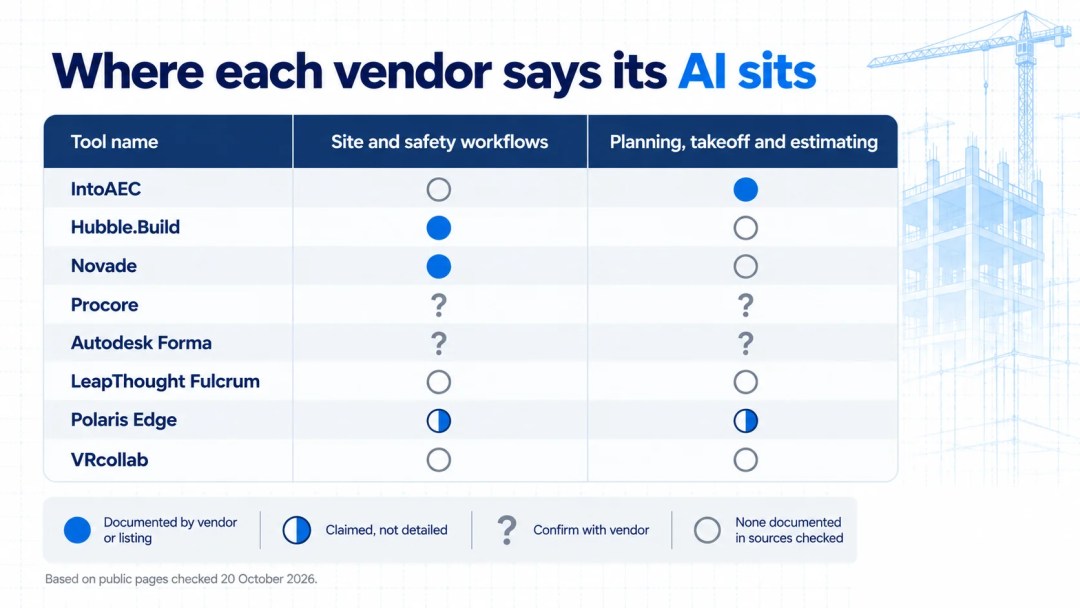
Every vendor now uses the word AI, but they do not mean the same thing. This table shows what each vendor says it automates, based on public pages.
| Tool | AI in site and safety workflows | AI in planning, takeoff and estimating |
|---|---|---|
| IntoAEC | None documented | Plan detection and trade assemblies in takeoff; Write with AI in estimates and proposals; schedule templates from a prompt |
| Hubble.Build | AI video analytics, per its App Store entry | None documented in the sources we checked |
| Novade | Form creation from PDF or prompt, speech-to-form, predictive safety score, video analytics integration | None documented in the sources we checked |
| Procore | Confirm with vendor | Confirm with vendor |
| Autodesk Forma | Autodesk Assistant across Forma; ask which features apply to site work | Forma Takeoff and Forma Estimate are listed; ask which use AI |
| LeapThought Fulcrum | None documented in the sources we checked | None documented in the sources we checked |
| Polaris Edge | AI integration claimed; features not detailed | AI integration claimed; features not detailed |
| VRcollab | None documented in the sources we checked | None documented in the sources we checked |
Treat any accuracy or time-saving figure a vendor quotes as a vendor claim. We have not repeated them here, because the only fair test is your own site data.
Which construction management platform fits your team?
The right option depends on your main constraint: site operations, BIM, estimating through delivery, or a vendor that BCA already uses as an example.
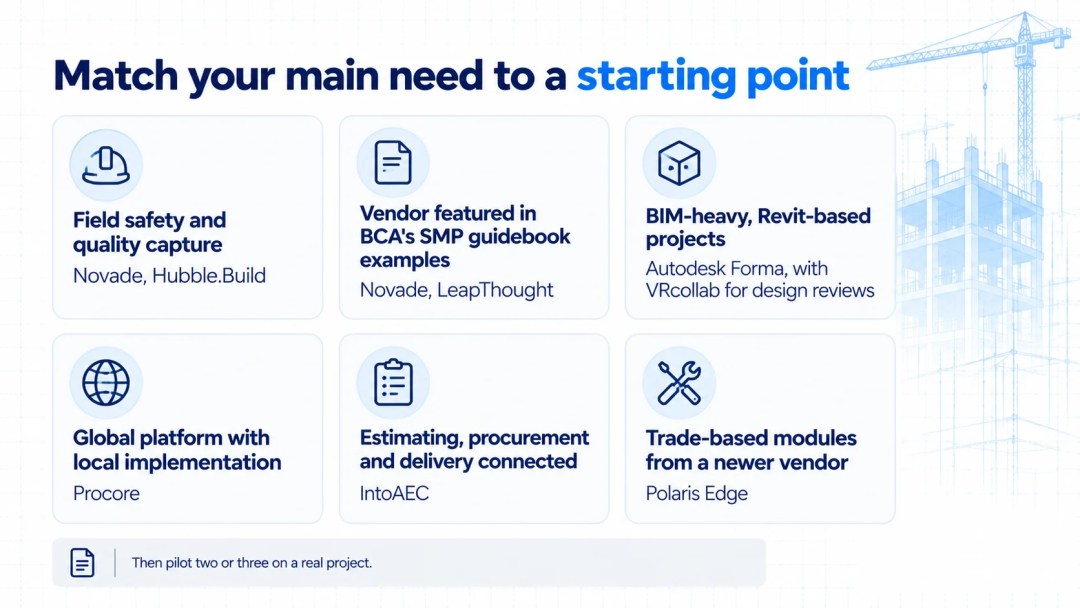
Start with the problem you actually have, then match it to a tool:
- Safety and quality capture is the priority. Novade and Hubble.Build are built around field operations.
- You want a vendor featured in BCA’s SMP guidebook examples. Novade and LeapThought both appear there.
- Your projects are BIM-heavy and Revit-based. Autodesk Forma fits, and VRcollab can support design reviews.
- You want a global platform with local implementation. Procore is worth a demo.
- You want estimating, procurement and delivery connected. IntoAEC is built for that scope.
- You want trade-based modules from a newer vendor. Polaris Edge is worth a reference check.
Whichever you shortlist, put the same questions to every vendor. Which of BCA’s SMP use cases do you cover, in writing? Can you share data with BCA’s data exchange platform? Where is our data hosted, and how do you meet Singapore’s PDPA? Do you bill in Singapore dollars and show GST clearly? Is support available in Singapore working hours? Which AI features are live today, and can you demonstrate them on our own data?
One more check matters. BCA may ask for access to your platform during an audit, so ask how each tool handles user access, audit trails and data export. This is a process question rather than legal advice, so speak to your adviser about your own obligations. If you also compare estimating tools, our PlanSwift alternatives guide uses the same method.
How do you pilot a new platform without disrupting a live site?
Pilot on one project first, map the platform to BCA’s use cases, and expand only after the site team confirms it works.
- List your use cases. Write down which of BCA’s SMP use cases and which internal workflows you need.
- Choose one live project. Pick a site with an engaged project manager and a manageable subcontractor group.
- Ask for a written mapping. Have each vendor show how its features cover your use cases.
- Test the AI on your own data. Use your forms, drawings and records, not the vendor’s demo content.
- Check data export before you sign. Confirm you can take your records with you if you switch later.
Make the shortlist decision on your own site data
The best platform is the one your site team will actually use under audit pressure. Construction management software Singapore sites rely on has to hold up on a real project, so shortlist two or three tools and pilot them there. Want to see how IntoAEC connects estimating, procurement and delivery in one workspace? Book a demo and bring a project of your own.

Frequently asked questions
It depends on your priorities. Novade and Hubble.Build suit field safety and quality, Autodesk Forma suits BIM-heavy projects, and Procore suits teams that want a global platform. IntoAEC suits firms that want estimating, procurement and delivery connected. Pilot two or three on a real project before you decide.
BCA publishes guidebooks for Site Management Platforms that set out use cases and recommended workflows. We found no BCA certification that makes a product compliant. Treat any such claim as a vendor statement, and ask for a written mapping to the use cases you need.
BCA describes a Site Management Platform as a centralised digital system used on construction sites to collect, manage and share project data. BCA uses SMPs in a tiered approach to site audits.
Novade lists an AI Suite with form capture and a predictive safety score, and Hubble lists AI video analytics. IntoAEC uses Zyra AI in takeoff, estimates, proposals and schedules, and Autodesk Forma includes an AI assistant. Ask each vendor which features are live today.
Most vendors in this guide do not publish prices in the sources we checked, so request a quote. Ask for Singapore dollar pricing, the number of users and modules included, and any implementation or training fees.
Related articles


Product information in this article was compiled from vendor pages, BCA’s published guidance and published reviews on 20 October 2026. Features and prices change, so confirm details with each vendor. BCA does not endorse any product named. All product names are trademarks of their respective owners, and IntoAEC is not affiliated with any of the other companies named.