

Table of contents
Australia has 462,939 construction businesses, and 98.6 per cent of them employ fewer than 20 people. That makes construction the largest industry in the country by business count, and also its biggest source of company insolvencies. If you are working out how to start a construction company here, the builder’s licence is only the first hurdle. Cash flow, contracts and accurate quotes matter just as much. This guide covers registration, licensing by state, insurance, payment rules and estimating. It also shows where AI tools like Zyra AI save time at each step.
A note before we start: IntoAEC publishes this guide and builds Zyra AI. We therefore have a commercial interest in the tools discussed. This is general information, not legal, tax or financial advice. Licence rules, thresholds and fees change, so confirm each point with the regulator or your adviser. We checked the figures and sources below in October 2026.
Why do construction businesses fail, and what should a new company learn from it?
Across industries, liquidators most often name cash flow and management problems as the reason a company failed.
ASIC’s analysis of liquidators’ reports for 2018-19, the latest edition we could find, shows the pattern. Of 7,498 reports, 51 per cent named inadequate cash flow or high cash use as a cause. Poor strategic management came next at 42.9 per cent, followed by trading losses at 38.9 per cent. Liquidators can nominate more than one cause, so the figures add up to more than 100.
Construction feels this more than most. It recorded 3,472 company insolvencies in 2025-26, the highest of any industry, out of 14,152 nationally. That is roughly a quarter of the total. To keep it in proportion, it equals about three-quarters of one per cent of the businesses operating in June 2025. The risk is real but manageable. You can plan for the causes liquidators cite from day one.
How to start a construction company: what do you register first?
Start with an ABN, choose your structure, and plan for GST registration once your turnover reaches $75,000.
Every business needs an Australian Business Number. If you set up a company, ASIC also gives you a nine-digit Australian Company Number. Many builders choose a Pty Ltd company because it is a separate legal entity with limited liability. It also adds director duties and reporting obligations. If you trade under a name other than your own or the company’s, register a business name as well. Your accountant or solicitor should confirm the right structure for you.
GST is the next trigger. You must register once your GST turnover reaches $75,000, and the ATO expects you to do it within 21 days. You can register earlier to claim GST credits on materials and equipment. That helps while you are buying more than you are billing.
No software registers a company for you. What it can do is keep your quoting and your books pointed the same way. IntoAEC has accounting integrations for Xero, QuickBooks and Zoho. Check which package your bookkeeper already uses before you pick any tool.
Which builder’s licence do you need in each state and territory?
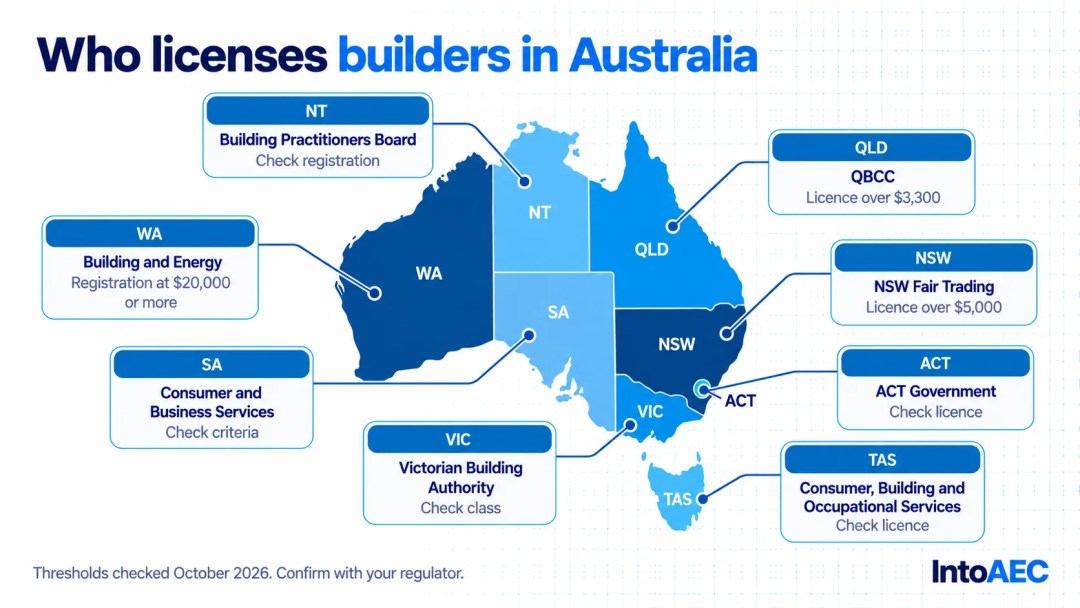
Builder licensing is set by each state and territory, so the regulator, the trigger value and the paperwork all differ.
Start with ABLIS, the Australian Business Licence and Information Service, to find the licences for your trade and location. Then confirm the details with the regulator below. Thresholds change, so treat this table as a starting point rather than a ruling.
| Jurisdiction | Regulator | What to check first |
|---|---|---|
| NSW | NSW Fair Trading | A contractor licence is needed for residential building work over $5,000, labour and materials included. Home building compensation cover applies to work over $20,000. |
| Victoria | Victorian Building Authority | Building practitioner registration, with different classes and eligibility rules depending on the type of building work. |
| Queensland | Queensland Building and Construction Commission | A QBCC licence of the right class is needed for building work valued over $3,300. |
| Western Australia | Building and Energy and the Building Services Board | Builder contractor registration for work of $20,000 or more that needs a permit. The Board generally expects at least $50,000 in cash or equivalent and a quick ratio of 1:1. |
| South Australia | Consumer and Business Services | A building work contractor licence under the Building Work Contractors Act 1995. Business criteria include training and financial requirements. |
| Tasmania | Consumer, Building and Occupational Services | A building services provider licence under the Occupational Licensing Act 2005. |
| ACT | ACT Government, Environment, Planning and Sustainable Development Directorate | A construction occupation licence under the Construction Occupations (Licensing) Act 2004, with nominee requirements for companies. |
| Northern Territory | Building Practitioners Board | Registration as a building contractor under the Building Act 1993. Individuals need written references from registered practitioners. |
What else you need before you start work
Two more points matter. First, you need a white card, which is general construction induction training, before you carry out construction work. Second, finances are part of the test in some states. Western Australia looks for evidence of cash and liquidity. South Australia tightened its licensing criteria from July 2020 after concerns that domestic builders were overextending themselves.
Western Australia’s regulator has also consulted on changing its $20,000 threshold, so check the current figure before you apply. No AI tool applies for your licence. But your licence class and scope decide which jobs you can legally price. Build that scope into your estimating templates from the start.
What insurance and payment rules protect a new construction company?
Home warranty insurance, written contracts and security of payment laws are your main protections, and all three vary by state.
Several states require home warranty or home indemnity cover once residential work passes a set value. NSW and Western Australia both use $20,000 as the trigger, according to their regulators. Check your state’s rule before you sign a domestic contract. Also review public liability and workers compensation with a broker. Business.gov.au lists the insurance types common in the industry.
Payment rules matter just as much. Every Australian state and territory has security of payment legislation. Examples include NSW and Victoria’s Building and Construction Industry Security of Payment Acts and Queensland’s Building Industry Fairness (Security of Payment) Act. These laws set out how you make a payment claim and how fast the other party must respond. The timeframes and steps differ from state to state. Missing a statutory deadline can leave you time barred, so learn your state’s rules before you send the first claim.
Standard-form contracts such as AS 4000 and AS 4902 sit alongside those laws. Both include variation procedures, so a change you agree on site but never document is a claim you may struggle to prove.
This is where records earn their keep. IntoAEC’s Change Order feature captures a scope change and applies it to the estimate. It then routes the change to the client for signature. This does not replace legal advice on your contract. What you do get is a signed record of what the client agreed.
Why do new construction firms run short of cash, and how do you plan for it?
Costs arrive weeks before payment does, so you need a forecast that follows your schedule, not just your bank balance.
A new builder pays wages, suppliers and insurance long before the client pays the first progress claim. ASIC’s liquidator data shows how often that gap ends badly. Inadequate cash flow was the top cause named in 2018-19. A few habits narrow the gap.
- Agree the payment schedule in the contract. Tie each claim to a visible milestone so the amount and the date are not up for debate.
- Claim on time, every time. Security of payment rules work in your favour only when you submit valid claims on the reference date.
- Track supplier bills against client receipts every week. The gap between the two is your real exposure.
- State GST clearly on every quote. Your margin should not shrink at BAS time because an amount was unclear.
- Hold a buffer. Regulators think this way too. Western Australia’s Building Services Board generally looks for $50,000 in cash or equivalent and a 1:1 quick ratio before it registers a builder contractor.

Zyra AI can draft a schedule template from a prompt, which gives you the dates your claims should fall on. IntoAEC also supports milestone-based invoices and an Invoice Pay Now option. Uploaded invoices can be read with OCR rather than retyped. The forecast and the payment terms are still yours to set. Our project scheduling page shows how the schedule side works.
How does accurate estimating protect your margin?
A quote built from measured quantities and current rates protects your margin before the first day on site.
Underpricing is a quiet way to lose money in a new business. You win the job, then find the quantities were light, the rates were old or a scope item was missing. Careful measuring from the plans is the fix, and it is also where AI helps most.
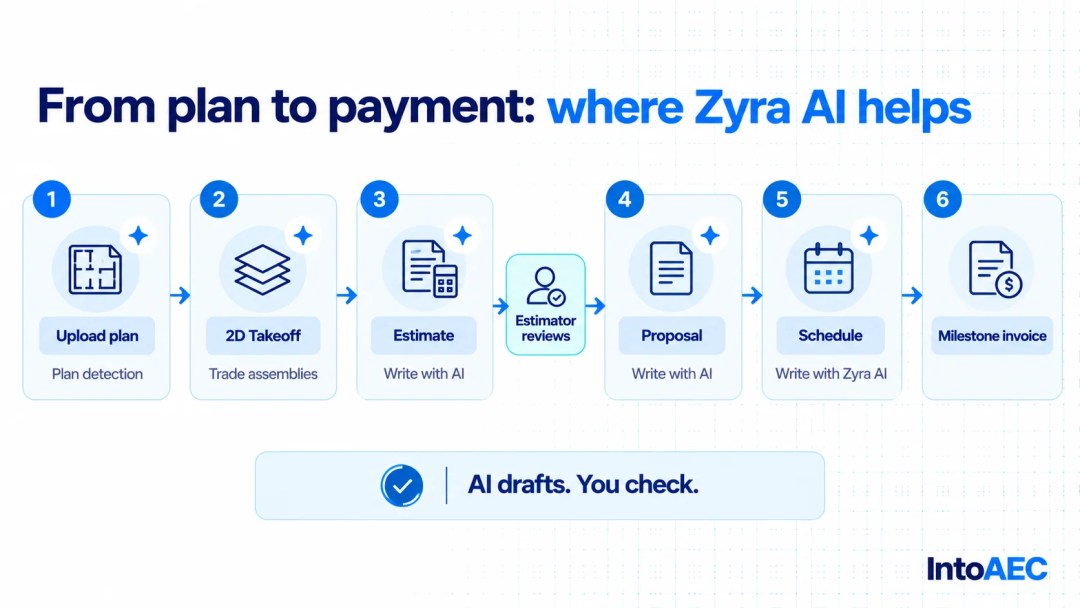
In IntoAEC, 2D Takeoff scans a plan with plan detection when you upload it. A Zyra AI panel can then generate trade assemblies. In Estimates, Write with AI turns a plain-language job description into line items with materials, quantities and rates. It also offers budget alternatives and rate analysis. You can then move to a proposal, where Write with AI drafts the wording. Our guide to the construction quote that wins the job covers the margin side in more depth.
Then check the code. The Building Code of Australia is Volumes One and Two of the National Construction Code. The edition that applies depends on where and when you apply for a permit. NCC 2025 became available for adoption on 1 May 2026. Victoria moved early, while NSW and Queensland deferred adoption until May 2027. An estimate priced against the wrong edition can miss requirements you will later have to pay for. Ask your certifier which edition applies to your project.
AI drafts the first pass. An estimator still checks every line against the plans, your supplier rates and the code. That judgement makes the number safe to send.
Where do AI tools help a new construction company, and where do they stop?
AI helps most with drafting and record-keeping. It helps much less with the licensing, legal and credit decisions that stay with you.
| Step | What it demands | Where Zyra AI and IntoAEC help | What stays with you |
|---|---|---|---|
| Registration and GST | ABN, structure, GST at $75,000 | Accounting integrations for Xero, QuickBooks and Zoho | Structure and tax decisions, made with your accountant |
| Licensing | Regulator application, white card, supervision | Not an AI task | The application and the qualifications behind it |
| Contracts and variations | Written terms and change control | Change Order with client sign-off | Contract terms and legal advice |
| Quoting | Takeoff, line items, proposals | Plan detection, Zyra trade assemblies, Write with AI in Estimates and Proposals | Checking quantities, rates, exclusions and the NCC edition |
| Cash flow | Claims, invoices, schedule | Schedule drafted from a prompt, milestone-based invoices, Invoice Pay Now | Payment terms, credit control and your cash buffer |
| Site and client reporting | Daily records and client updates | Daily Report and Client Report | What you report and when |
IntoAEC is not the only option. Our PlanSwift alternatives guide compares five estimating platforms, including four from other vendors, and explains how we chose them.
What should you do in your first 90 days?
Sequence the work so that licence, insurance and cash-flow planning happen before your first big quote.
- Confirm your licence class and scope. Speak to your state regulator and check ABLIS.
- Register your ABN, structure and GST plan. Do this with an accountant.
- Arrange insurance. Compare home warranty, public liability and workers compensation with a broker.
- Have your contract templates reviewed. A construction solicitor can check variations and payment terms against your state’s security of payment rules.
- Build a rolling cash-flow forecast. Update it every week against your schedule and your invoices.
- Test your estimating on a closed job. Run a project you already know through takeoff and estimating, then compare the results line by line.
Start with the numbers in order
Licences get you onto site, but cash flow and accurate quotes keep you there. Want to see how Zyra AI drafts a takeoff, an estimate and a proposal? Book a demo and bring a plan set of your own.

Frequently asked questions
There is no single figure. Costs depend on your structure, licence class, insurance and equipment. You also need working capital to fund wages and materials until clients pay. As one reference point, Western Australia’s Building Services Board generally expects builder contractor applicants to show access to $50,000 in cash or equivalent. Get quotes from your regulator, insurer and accountant.
Usually yes, once the work passes a state threshold. Examples are residential work over $5,000 in NSW and building work over $3,300 in Queensland. In Western Australia, it is builder work of $20,000 or more that needs a permit. Rules differ by state, so check ABLIS and your regulator.
Licensing generally requires qualifications and experience. In the Northern Territory, for example, individual contractors need written references from registered building practitioners. Some states let a company rely on a qualified nominee or supervisor, so ask your regulator what it accepts.
You must register once your GST turnover reaches $75,000, within 21 days of becoming aware you will pass it. Below that, registration is optional. Many new builders register early so they can claim GST credits on purchases.
AI speeds up first drafts of work such as takeoff, estimates, proposals and schedules. In IntoAEC, Zyra AI drafts estimate line items, trade assemblies and schedule templates from your inputs. An estimator should still review everything before it goes to a client.
Related articles


This guide is general information only and is not legal, tax, financial or insurance advice. Licence thresholds, fees and codes change, so confirm details with your state regulator, accountant and solicitor. Sources were checked in October 2026. All product names are trademarks of their respective owners.