

Table of contents
It is the last week of the month, and your QS has just received the architect’s certificate for Progress Claim 7, worth RM480,000. Until recently, you would email a PDF invoice and wait for payment. Now that invoice may need to be issued as an e-invoice. LHDN’s MyInvois system validates it and returns an identifier and a QR code. If you searched for LHDN e invoice rules for construction, you want one answer: what must a contractor do, and by when? This guide gives that answer for Malaysian contractors, based on the rules in force on 20 October 2026.
IntoAEC publishes this guide. It is general information, not tax or legal advice. LHDN has updated its guidelines several times in 2026. So we checked the e-Invoice Guideline (version 4.8, 30 August 2026), the Specific Guideline (version 4.9, 7 September 2026), LHDN’s construction FAQ (6 January 2026) and adviser alerts. Check LHDN’s live pages and your tax adviser before you act.
What is the current LHDN e-Invoice timeline for contractors?
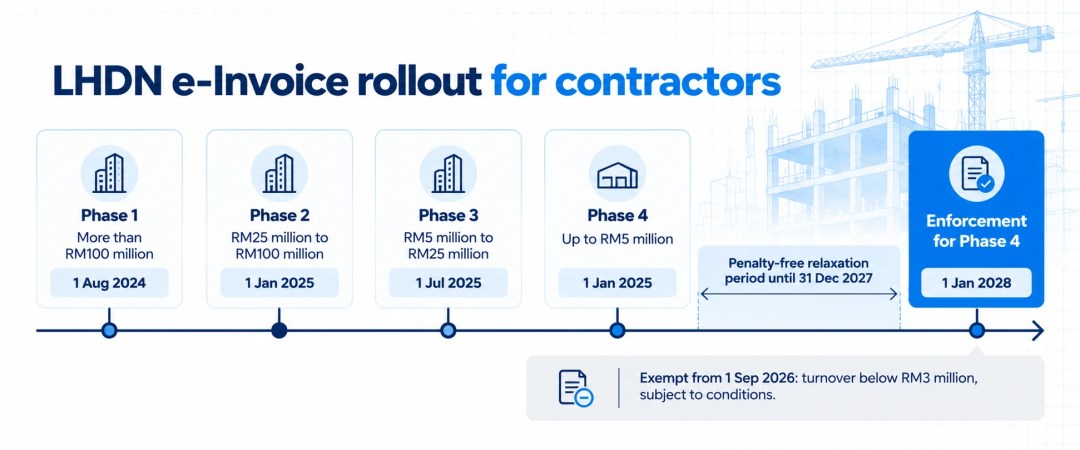
Phase 4 contractors started on 1 January 2026, and penalty enforcement for them begins on 1 January 2028.
LHDN phased the mandate by annual turnover or revenue. The table shows each band, its start date and when its penalty-free relaxation period ended or ends.
| Phase | Annual turnover or revenue | Implementation date | Penalty-free relaxation period |
|---|---|---|---|
| Phase 1 | More than RM100 million | 1 August 2024 | Ended 31 January 2025 |
| Phase 2 | More than RM25 million, up to RM100 million | 1 January 2025 | Ended 30 June 2025 |
| Phase 3 | More than RM5 million, up to RM25 million | 1 July 2025 | Ended 31 December 2025 |
| Phase 4 | Above the exemption threshold, up to RM5 million | 1 January 2026 | Until 31 December 2027; enforcement from 1 January 2028 |
| Exempt | Below RM3 million, subject to conditions | From 1 September 2026 (previously RM1 million) | Not applicable |
Four details change how you plan:
- The relaxation period pauses penalties, not the obligation. LHDN said it would not prosecute under section 120 of the Income Tax Act 1967 during the period, if taxpayers followed the consolidated e-invoice requirements.
- Phases 1 to 3 face enforcement now. Their relaxation periods have finished.
- Phase 4 penalties start in 2028, not 2027. You may read otherwise in older articles. LHDN extended the Phase 4 relaxation period to 31 December 2027, so enforcement starts on 1 January 2028.
- There is no Phase 4A in the sources we found. Some summaries mention one, but LHDN’s published timeline lists four turnover bands.
One caution on sources. When we checked, an LHDN timeline page still showed the earlier RM1 million exemption, while adviser alerts reported the RM3 million change. Confirm the current figure on LHDN’s site.
How do the RM3 million exemption and group rules apply to contractors?
From 1 September 2026, businesses below RM3 million are generally exempt. Group and joint venture links can remove that exemption.
The e-Invoice Guideline version 4.8, published on 30 August 2026, raised the exemption threshold from RM1 million to RM3 million, according to adviser summaries and a Grant Thornton Malaysia alert. The exemption does not apply in three situations:
- The taxpayer has a non-individual shareholder, or equivalent, with annual turnover or revenue of at least RM3 million.
- The taxpayer is a subsidiary of a holding company with annual turnover or revenue of at least RM3 million.
- The taxpayer has a related company or joint venture with annual turnover or revenue of at least RM3 million.
Construction firms often sit in groups or join project joint ventures. Check these conditions before you stop issuing e-invoices. The exemption is also not permanent. If revenue later reaches the threshold, e-invoicing starts on 1 January of the second year after the year it was reached. For example, reaching RM3 million in YA2026 means a 1 January 2028 start.
What does LHDN say about construction progress claims?
LHDN’s construction FAQ requires an e-invoice for a property progress claim. Where a certificate of work done is required, the e-invoice can follow the certificate.
The FAQ, last updated on 6 January 2026, covers four situations:
- Progress claims. If no certification is required, the contractor issues the e-invoice to substantiate the income. If it is required, the e-invoice can follow the certificate.
- Sub-contractor charges. Contractors, as defined in the Income Tax (Construction Contracts) Regulations 2007, must issue e-invoices for charges to sub-contractors, including penalties.
- Materials bought on the owner’s behalf. The main contractor may keep its current billing arrangement, but the invoices it issues must be e-invoices.
- Materials sold to related companies. If the buyer requests an e-invoice, issue one. Otherwise the seller may issue receipts and consolidate them within seven calendar days after month end.
The FAQ’s four answers do not mention retention releases, variation orders or advance payments. Ask your tax adviser how LHDN expects those to be invoiced. Use the certificate date as your anchor for progress claims. Our guide to subcontractor payment disputes in Malaysia explains why documented approvals matter on the payment side too.
Does the no-consolidation rule apply to progress claims?
From 1 January 2026, a single transaction above RM10,000 cannot go into a consolidated e-invoice. Most progress claims are far above that.
A consolidated e-invoice lets a supplier aggregate transactions where the buyer does not ask for an e-invoice. It must be issued within seven calendar days after month end. The rule that any single transaction above RM10,000 needs its own e-invoice applies from 1 January 2026, according to a summary of the HASiL statement. It is a general rule rather than a construction-specific one, but construction feels it most. Your RM480,000 certified claim cannot sit in a monthly batch.
There is a transition nuance. While a taxpayer’s relaxation period runs, LHDN said consolidated e-invoices were permitted for all transactions. So Phase 4 contractors can still consolidate until 31 December 2027 without prosecution risk, provided they follow the consolidation requirements. Our view is that issuing individual e-invoices for claims above RM10,000 now avoids a rebuild in 2028.

One conflict to resolve. Some summaries say consolidated e-invoices are barred for construction materials sales. LHDN’s own construction FAQ allows consolidation for materials sold to related companies that do not request an e-invoice. Check sections 3.5 and 3.6 of the Specific Guideline for your case.
What are the penalties, and what does the SVDP offer?
Failing to issue an e-invoice is an offence under section 120(1)(d) of the Income Tax Act 1967. The fine is RM200 to RM20,000, up to six months’ imprisonment, or both, for each non-compliance.
That wording comes from LHDN’s FAQ, as quoted by Wolters Kluwer. Because the penalty applies per non-compliance, missed invoices are counted one by one, not as a batch. LHDN has also opened a Special Voluntary Disclosure Programme (SVDP) for e-invoices. It runs from 7 July 2026 to 31 December 2027.
- It lets taxpayers regularise missing, incomplete or incorrect e-invoice submissions without penalty.
- It is not available where the disclosure involves fraud, wilful default or negligence.
- Per EY’s summary, a transaction above RM10,000 on or after 1 January 2026 that was not reported by a transactional e-invoice can be regularised, except for transactions made during the interim relaxation period.
- Disclosures use dedicated e-Invoice Version identifiers, SVDP 1.2 without a digital signature and SVDP 1.3 with one. Ask your software provider whether it supports them.
How should a contractor’s billing workflow change?
The change is operational. Each certified claim becomes its own validated record, so billing, certificates and project costs need to line up.
- Trigger on the certificate. Where certification is required, issue the e-invoice once you hold the certificate.
- Capture buyer and supplier details early. Collect the buyer’s tax identification details and confirm your own classification codes at contract stage, before the first claim.
- Submit and validate. The supplier submits through the MyInvois Portal or an API. LHDN validates it in near real time, and the supplier shares the validated e-invoice with the buyer, as described in a UOB SME Hub guide.
- Log each claim against the contract. Record the claim number, certificate number and validation identifier together.
- Reconcile to project cost. Compare claimed, certified and received amounts with cost to date after every claim.
That last step is where compliance and job costing meet. Contractors often learn they have lost margin only at the final account. Our guide to construction job costing covers that problem. Each validated claim is a dated, certified record. If your project system can see it, you can compare billed value with cost to date after every claim.
An illustrative example. These figures are invented for illustration. On a RM3.2 million contract, Claim 7 is certified at RM480,000 on 14 October. You issue one e-invoice for that amount and keep these fields together:
- Claim number and certificate reference
- Certificate date and e-invoice issue date
- E-invoice amount and validation identifier
- Payment received date and amount
- Cumulative billed value against cost to date

Where does IntoAEC fit in an e-invoice workflow?
IntoAEC handles the project side of a progress claim. The LHDN submission happens in an accounting system connected to MyInvois.
We have not documented IntoAEC submitting invoices directly to MyInvois, and we do not claim that it does. Contractors who need LHDN validation should issue and validate e-invoices in an LHDN-connected accounting system or ERP. Bukku says it can submit e-invoices directly to LHDN, according to the same UOB SME Hub article.
IntoAEC’s Bukku integration, announced in June 2025, syncs invoices and payments from Bukku into IntoAEC. Sync can run hourly, daily or manually. That gives project teams visibility of customer transactions within project workflows. IntoAEC’s Invoice and Payment module also supports milestone-based invoices and online payment, and change orders can carry a client signature.
- Pro: project teams see invoices and payments next to the schedule, estimates and costs
- Pro: milestone-based invoicing and a client signature on change orders support a clean certificate trail
- Con: IntoAEC is not documented as an LHDN e-invoice submitter, so you still need a connected accounting system
- Con: the integration scope is as announced in June 2025, so confirm current coverage with IntoAEC support before relying on it
What should you ask your accounting software provider?
Ask every provider the same questions. LHDN updated its guidelines three times in about two months in 2026.
- Which guideline versions do you support, including e-Invoice Guideline 4.8 and Specific Guideline 4.9?
- Can the system route any transaction above RM10,000 to individual issuance automatically?
- Can progress claims trigger e-invoice issuance from a certificate date?
- Do you support sub-contractor charge e-invoices and self-billed e-invoices?
- Do you support the SVDP 1.2 and SVDP 1.3 versions for voluntary disclosures?
- How do you handle credit notes, debit notes and corrections after validation?
- Can I export every validated e-invoice with its identifier for audit?
- How does the system share invoice data with my project management software?
Which key dates belong in your calendar?
Eight dates matter for Malaysian contractors through 2028, and the last one is the date many articles get wrong.
| Date | What happens | Why it matters |
|---|---|---|
| 1 January 2026 | Phase 4 starts; single transactions above RM10,000 need their own e-invoice | The start of the individual-invoice rule |
| 20 April 2026 | Specific Guideline 4.7 extends the Phase 4 relaxation period to 31 December 2027 | Penalties for Phase 4 move out by 12 months |
| 7 July 2026 | e-Invoice SVDP opens | A penalty-free route to fix past gaps |
| 30 August 2026 | Guideline 4.8 and the RM3 million exemption are announced | Many firms may fall out of scope |
| 1 September 2026 | RM3 million exemption takes effect | Check group and joint venture conditions |
| 7 September 2026 | Specific Guideline 4.9 replaces 4.8 | Confirm your software follows the latest version |
| 31 December 2027 | Phase 4 relaxation period and SVDP end | Last penalty-free day for Phase 4 |
| 1 January 2028 | Phase 4 penalty enforcement begins, not 2027 | Individual e-invoices must be in place |
Turn every certified claim into a project record
A validated e-invoice proves the claim to LHDN. A project record proves it to your team. Want to see how IntoAEC keeps certificates, change orders, invoices and costs together? Book a demo and bring one real progress claim.

Frequently asked questions
It depends on annual turnover or revenue. Phase 4 contractors, up to RM5 million, started on 1 January 2026. Taxpayers below RM3 million are generally exempt from 1 September 2026, subject to group and joint venture conditions.
Yes. LHDN’s construction FAQ requires an e-invoice for a property progress claim. Where a certificate of work done is required, the e-invoice can be issued once the certificate is obtained.
Not for transactions above RM10,000 from 1 January 2026. During a taxpayer’s relaxation period, LHDN allowed consolidation for all transactions. Phase 4 contractors therefore have until 31 December 2027 before enforcement.
It is an offence under section 120(1)(d) of the Income Tax Act 1967. The fine is RM200 to RM20,000, up to six months’ imprisonment, or both, for each non-compliance.
Phase 4 enforcement begins on 1 January 2028, after the relaxation period ends on 31 December 2027. The SVDP also runs to 31 December 2027 for correcting past gaps.
Related articles


This guide is general information based on LHDN publications and adviser alerts checked on 20 October 2026. It is not tax, accounting or legal advice, and the rules may change. Confirm with LHDN and your tax adviser. Product names are trademarks of their owners, and IntoAEC is not affiliated with LHDN, Bukku, AutoCount or the other firms cited.