

Table of contents
- How much does concrete cost per m³ in Australia in 2026?
- What are the 6 cost drivers behind the price of concrete per m³?
- Why does this matter more for Australian contractors right now?
- How do you check whether your concrete cost estimate is accurate?
- How does BOQ software help contractors control concrete costs?
- Conclusion
- Frequently asked questions
A driveway-and-slab pour quoted at $260 per m³ in January can land on site in June at $310. By the time you reconcile the delivery docket against the tender, the difference has already eaten into the job’s margin. This rarely happens because of a careless quote. It happens because a single “concrete cost per m³” figure travels through the BOQ as one number. The variables that actually move price on pour day never get separated out. This guide sets out current 2026 pricing by strength grade, then the 6 cost drivers behind every concrete line item. That way, the number in your estimate still holds up against the invoice.
Standard ready-mix concrete costs roughly $200–$450 per m³ delivered in Australia in 2026, with most 20–25 MPa residential and light-commercial pours priced between $250 and $370 per m³ before delivery, pump hire, and labour are added. The spread exists because six variables move independently on any given job: strength grade, delivery distance, load size, state-based labour rates, seasonal demand, and finish or admixture requirements. Treat a single “cost per m³” figure as a BOQ starting point, not a finished quote.
How much does concrete cost per m³ in Australia in 2026?
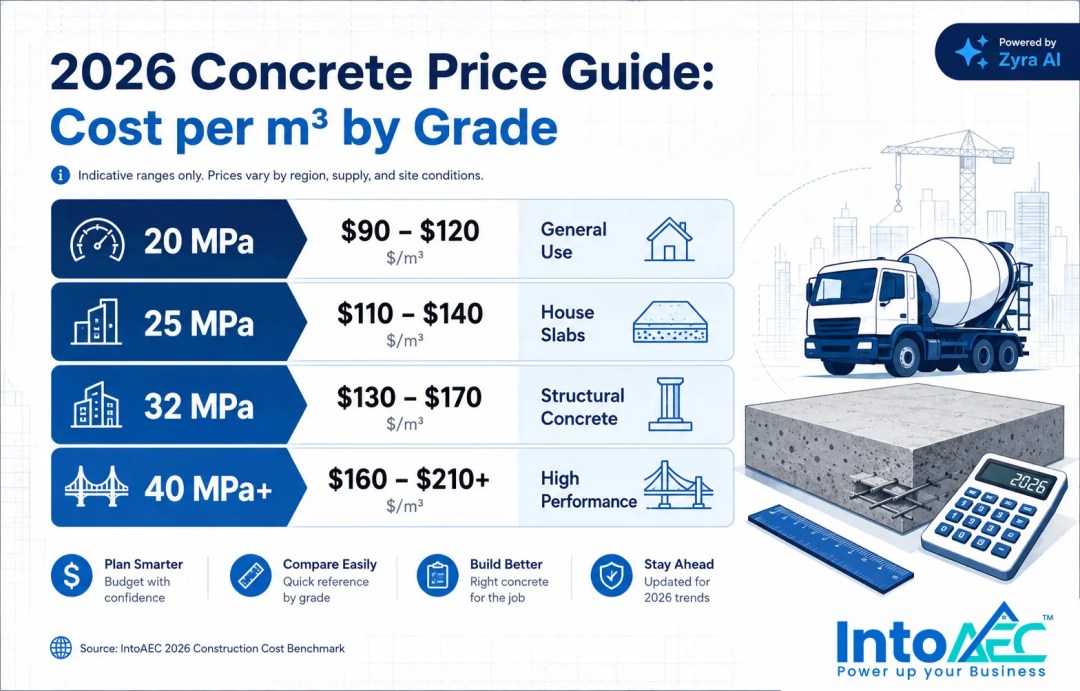
Standard ready-mix concrete costs between $200 and $450 per m³ delivered in 2026, with the exact figure driven mainly by strength grade. The table below sets out the current indicative range by MPa grade.
| Grade | Common Use | Indicative Price per m³ (delivered, ex-GST) |
| 20 MPa | Paths, non-structural fill, light residential slabs | $200–$300 |
| 25 MPa (N25) | Driveways, house slabs, footings — most common residential spec | $250–$370 (Sydney N25 typically $340–$370) |
| 32 MPa | Commercial slabs, suspended slabs | $320–$420 |
| 40 MPa+ | Industrial floors, high-load structural elements | $350–$500 |
If you’ve compared concrete costs across different guides and the numbers didn’t agree, this is usually why: some sources quote the raw ex-plant supply rate per m³, while others fold in delivery, pump hire, or installed labour and finishing costs. Builders conventionally price those labour and finishing costs per m², not per m³. For an accurate BOQ line item, keep these separate. List the supply rate per m³ on its own line. List delivery and short-load fees on another. List labour or finish cost per m² as a distinct trade item.
It’s also worth building the direction of travel into a contingency line. Ready-mixed concrete producer prices rose 1.7% in the March 2026 quarter alone, pushed up by higher production costs. A rate locked in at tender stage can still move by the time a long project reaches its concrete-heavy phases.
What are the 6 cost drivers behind the price of concrete per m³?
1. Strength grade (MPa)
The pour’s specified compressive strength sets how much cement the mix needs, and therefore its base cost. A garden path might only need 20 MPa, while a suspended commercial slab needs 32 MPa. Specify a grade higher than the engineer’s drawings call for “to be safe,” and you add $70–$100 per m³ with no structural benefit.
2. Delivery distance and location
The distance from the nearest batching plant to site adds a fee on top of the mix rate. A standard delivery within 20 km typically adds $80–$120 per load, more for regional or hard-to-access sites. Price a job off a flat, company-wide concrete rate without checking which plant services it, and two sites the same distance apart on a map can still land on very different delivered costs.
3. Load size
Whether the pour meets the batching plant’s minimum order matters, because the plant bills a short load to cover the cost of sending the truck regardless of volume. An order under roughly 4 m³ can attract a $50–$200 short-load fee. Split a job into several small pours instead of consolidating them, and the cumulative short-load fees can outweigh whatever staging the work aimed to save.
4. State-based labour rates
The installed and finishing labour cost per m² differs by state, because enterprise agreements and award rates aren’t uniform nationally. Installed labour runs roughly $65–$110 per m² in SA, against $70–$140 per m² in VIC, for comparable slab work. Assume the total job cost will match a contractor’s quote from another state just because the material rate matches, and the labour line underneath it can tell a very different story.
5. Seasonal and demand timing
The time of year and day of the week you book a pour both move price, through supply, demand, and penalty rates. Spring and early autumn count as peak pouring seasons in NSW and VIC, when spot prices can rise 5–10%. Weekend pours commonly add a $50–$80 surcharge. Lock in a pour date without checking the season, and a program-critical weekend slot can cost more than the schedule ever budgeted for.
6. Finishes and admixtures
Any decorative finish or structural admixture carries its own separate cost, on top of the base supply rate. Coloured or exposed-aggregate finishes run roughly $110–$120 per m², on top of the base mix cost. Fold a finish or an admixture into a single blended “concrete” rate instead of its own BOQ line, and it stops moving in line with the actual supply price the moment either changes.

Why does this matter more for Australian contractors right now?
Concrete cost movement carries extra weight on Australian projects because most standard-form contracts, including AS 4000 and AS 4902, only pass through material cost changes if a rise-and-fall provision was included as an annexure item at contract signing. If it wasn’t, a genuine price increase between tender and pour has nowhere to go except the contractor’s margin. Security of Payment legislation, which differs by state (NSW, VIC, and QLD each have their own variant), then governs how any variation for a material cost increase has to be raised and progressed — so a concrete rate movement on a live job needs to be documented as a formal claim, not adjusted informally against the next progress payment. Contractors who price the six drivers above as separate BOQ lines from the outset spend far less time arguing about whether a cost increase was foreseeable.
How do you check whether your concrete cost estimate is accurate?
Run the six drivers above against your BOQ line before it goes out to tender, not after the invoice lands. Confirm the grade matches the structural drawings rather than a template default, check which batching plant is servicing the site and its delivery zone, size pours to avoid short-load fees, price labour at the state’s actual rate rather than a national average, flag any weekend or peak-season pours, and cost finishes or admixtures as their own line. If any of these is missing, blended into a single rate, or copied from a previous job in a different state, that is the gap a tighter competitor’s tender — or a mid-project cost blowout — will find first.
How does BOQ software help contractors control concrete costs?
BOQ software helps because it enforces this structure the way a spreadsheet never can. A blank spreadsheet doesn’t warn you when a concrete line is missing a delivery zone or blending a finish into the base rate, but a structured BOQ builder does. With IntoAEC, your 2D takeoff feeds directly into a structured BOQ software estimate where grade, delivery, load size, labour, timing, and finishes are priced as separate lines, so a rate change on any one of them recalculates the job cost instead of surfacing later as an unexplained variance. Zyra AI checks the BOQ in the background for stale rates and pricing gaps. You do not interact with the AI. You just stop doing the work it handles.
Conclusion
A concrete cost per m³ figure is only as reliable as the six variables underneath it, and missing any one of them rarely shows up at tender stage. It shows up later, as a margin nobody can fully account for. Want a BOQ where every concrete line item prices these six drivers automatically?

Frequently asked questions
Standard ready-mix concrete costs roughly $200–$450 per m³ delivered in Australia in 2026, with most 20–25 MPa residential and light-commercial pours priced between $250 and $370 per m³ before delivery, pump hire, and labour are added.
20 MPa concrete, used for paths and non-structural fill, typically costs $200–$300 per m³ delivered, while 32 MPa, used for commercial and suspended slabs, typically costs $320–$420 per m³ — a difference driven mainly by the higher cement content needed to reach the greater compressive strength.
No. The per-m³ figure is the ex-plant supply rate for the mix itself; delivery (commonly $80–$120 within a standard zone), short-load fees for orders under about 4 m³, and pump hire are quoted and charged separately, and should be priced as their own BOQ line items.
The main reasons are plant distance from site, order size relative to the minimum load, the day and time of the pour, and whether a quote bundles installed labour or finishing costs into the headline per-m³ or per-m² figure rather than pricing them separately.
Related articles
- What Is BOQ in Construction? Meaning, Types, Components and Uses (2026)
- Bill of Quantities Explained: 8 Components of a Winning BOQ (2026)
- 7 Types of BOQ Every Estimator Should Know (with Examples)
- How Australian Contractors Are Finally Winning the Construction Budget Crisis
- Best Construction Procurement Software in Australia for Contractors and Quantity Surveyors
- Why the Smartest Construction Firms in Australia Have Quietly Stopped Using Excel